
Building complex structures in one go: World's first successful one-step synthesis of a "hand basket" compound from string-like molecules


Building complex structures in one go
- World's first successful one-step synthesis of a "hand basket" compound from string-like molecules -
The research team of Yusuke Tomita (3rd year doctoral student), Graduate School of Engineering Technical Specialist Sayori Kiyota of the National University Corporation Graduate School of Engineering Department of Applied Chemistry Tokyo University of Agriculture and Technology, Nobuyuki Komine of the Graduate School of Institute of Engineering Division of Applied Chemistry, Assistant Professor and Professor Masafumi Hirano of the National University Corporation, For the first time in the world, we have succeeded in synthesizing a three-dimensional "hand basket-shaped" compound using two string-like (chain) unsaturated molecules, acetylene derivatives and conjugated hexatriene, in a single process. The resulting compound has a bicyclo[3.2.1]octadiene backbone, a reaction in which carbon-carbon bonds are formed and cleavaged simultaneously. This result is expected to be a powerful means for synthesizing skeletons such as complex natural products and pharmaceutical and pesticide intermediates from simple raw materials.
The results of this research were published in the American Chemical Society's Organic Letters (online edition, August 16).
Paper title: Cobalt-Catalyzed Bicycloaddition of Alkynes with Conjugated Trienes Yielding Bicyclo[3.2.1]octadienes
URL: https:/doi.org/10.1021/acs.orglett.5c02991
Current Situation
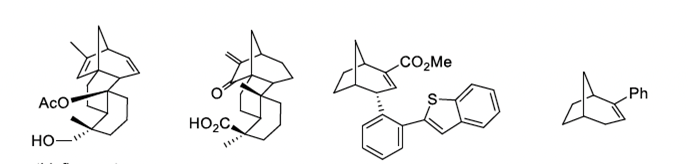
Bicyclo[3.2.1]octane derivatives with a "hand basket-shaped" (Figure 1) skeleton are widely known to exhibit biological activities such as antitumor and antibacterial activities (Figure 2). These molecules have a three-dimensional structure, and known synthetic methods include (1) cyclizing a chain molecule through a multi-step reaction, and (2) constructing the handle of the hand basket using a cyclic compound as a starting material. However, these synthetic methods require multiple steps, making them time-consuming and labor-intensive.
If such a three-dimensional molecular framework could be constructed by spinning string-like molecules, it would lead to the synthesis of molecules with complex three-dimensional structures from relatively simple molecules. However, to achieve this reaction, it is necessary to form carbon-carbon bonds, which are the basic structure of organic molecules, while also breaking some carbon-carbon bonds. Therefore, creating these structures in one step is extremely difficult, and this type of reaction was previously unknown.

Research Structure
This research was conducted by Yusuke Tomita (3rd year doctoral student), Tokyo University of Agriculture and Technology Graduate School, Technical Specialist Sayori Kiyota, Institute of Engineering Division of Applied Chemistry Graduate School of Engineering Graduate School of the same school, Nobuyuki Komine Assistant Professor, and Professor Masafumi Hirano. This research was supported by the FLOuRISH program and part of the JSPS Grants-in-Aid for Scientific Research (B) (24K01479).
Research Results
So far, our research group has investigated the cobalt complex [CoBr 2 (dppe)] (Note 1) The world's first bicyclocyclization reaction using acetylene and butadiene derivatives as a catalyst precursor to synthesize the "chair-type" compound bicyclo[3.1.0]hexene. (Note 2) (Figure 3) 1.
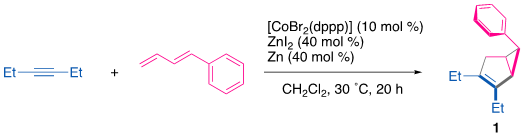
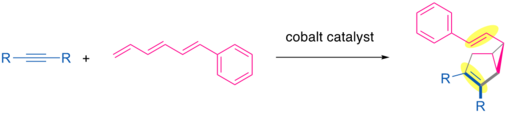
In this reaction, it was confirmed that the phenyl group (benzene ring) in the "chair-type" compound produced was selectively introduced to the more crowded side. (Note 3) Therefore, the researchers hypothesized that if a hexatriene derivative, which is a compound in which one C=C bond of a butadiene derivative is extended, were used as the starting material, a similar "chair-type" compound would be formed, and then the two C=C bonds facing each other within the molecule would further react to form a three-dimensional structure (Figure 4).
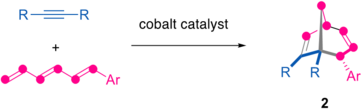
Based on this hypothesis, we actually performed the reaction using a hexatriene derivative instead of a butadiene derivative, and found that the completely new "hand basket" compound 2 was produced stereoselectively in one step (Figure 5).
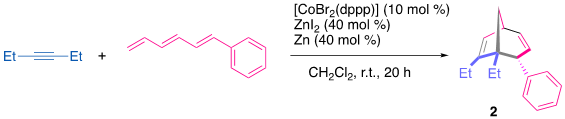
In this reaction, four new carbon-carbon bonds are formed, as shown in Figure 6. At the same time, the carbon chain derived from hexatriene branches, and unless one carbon-carbon bond is broken, a product like 2 cannot be produced. It is extremely interesting that such a complex reaction can proceed stereoselectively with just one catalytic step.
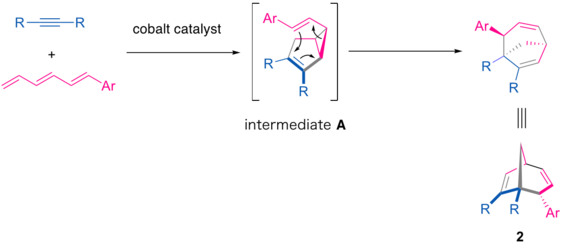
After further experiments, it was determined that, as initially hypothesized, a "chair-type" compound was produced as an intermediate (intermediate A in Figure 7), and that the reaction then proceeded spontaneously even at room temperature, with simultaneous bond cleavage and formation occurring through a [3.3] sigmatropic rearrangement (Note 4) known as the vinylcyclopropane rearrangement, ultimately producing the "hand basket-type" compound 2 (Figure 7).
Future Developments
This successful catalytic reaction to produce a "hand basket-type" compound from two string-like (chain-like) unsaturated molecules in one step is the world's first example. By elucidating the reaction mechanism, we will advance the development of catalysts that enable even more efficient synthesis. Furthermore, the product, a derivative with a bicyclo[3.2.1]octane skeleton, has a skeleton commonly found in biologically active molecules, and is therefore expected to lead to the efficient synthesis of anticancer drugs, antibacterial agents, and other drugs. Because this reaction is unique in that it allows the skeleton to be constructed from simple molecules, it has the potential to significantly contribute to simplifying pharmaceutical synthesis processes and reducing manufacturing costs.
References
1) Tomita, Y.; Haraguchi, N.; Kiyota, S.; Komine, N.; Hirano, M. Org. Lett. 2022, 24, 7774-7778.
Terminology
(Note 1) dppp
DPPP is an abbreviation for 1,3-bis(diphenylphosphino)propane, a ligand containing two phosphorus atoms. Generally, a ligand is needed to stabilize a complex, and phosphorus ligands are commonly used. In this reaction, the discovery that a cobalt complex coordinated with DPPP, among the many ligands available, promotes this reaction led to the discovery of a new reaction.
(Note 2) Bicyclocyclization reaction
A compound in which two adjacent ring structures share a single bond, such as a carbon-carbon bond, is called a bicyclic compound. We were the first in the world to report a reaction to synthesize a bicyclic compound from a chain molecule in one step (Reference 1).
(Note 3) The more crowded side
This expresses the ability to selectively create molecules in which the benzene ring faces the more crowded, concave space. More technically, this is called endo-selectivity.
(Note 4) [3.3] Sigmatropic rearrangement
A single bond is also called a sigma bond, and a reaction in which the position of this bond changes is called a sigmatropic rearrangement. [3.3] shows the position where a new sigma bond is formed between the third positions of the atoms being broken.
◆Inquiries about Research◆
Masafumi Hirano
Professor,
Division of Applied Chemistry, Graduate School of Engineering, Tokyo University of Agriculture and Technology,
TEL/FAX:042-388-7044
E-mail: hrc (put @ here) cc.tuat.ac.jp
Related links (opens in a new window)
- Tokyo University of Agriculture and Technology and Technology, Professor Masafumi Hirano Researcher Profile
- Tokyo University of Agriculture and Technology, Assistant Professor Nobuyuki Komine Researcher Profile
- Tokyo University of Agriculture and Technology and Technology, Professor Masafumi Hirano and Assistant Professor Nobuyuki Komine Laboratory Website
- Professor Masafumi Hirano and Assistant Professor Nobuyuki Komine are affiliated with Department of Applied Chemistry, Faculty of Engineering, Tokyo University of Agriculture and Technology.