
Clarification of environmentally friendly synthesis conditions for AgBiS2 nanocrystals - Prospective for high-performance photodetector applications -


Clarifying the synthesis conditions for environmentally friendly AgBiS2 nanocrystals
- Prospective for high-performance photodetector applications -
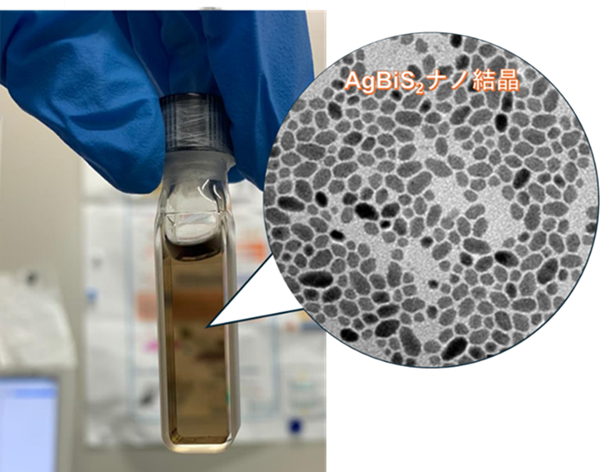
At Tokyo University of Agriculture and Technology, Fidya Azahro Nur Mawaddah and Dadan Suhendar, graduate students of the Department of Applied Physics and Chemical Engineering in Graduate School of Engineering, Associate Professor Satria Zulkarnaen Bisri, Division of Advanced Electrical and Electronics Engineering in Institute of Engineering, and Professor Hiroki Minoda and Assistant Professor Toshiki Shimizu, Division of Advanced Applied Physics in Institute of Engineering revealed that AgBiS 2 nanocrystals, which are expected to be applied to solar cells and photodetectors as environmentally friendly materials, can be obtained with different compositions depending on the temperature during the synthesis reaction. This allows for more precise control of the synthesis of AgBiS 2 nanocrystals. They also found that this material enables the demonstration of high performance photodetectors. This achievement is expected to contribute to the realization of environmentally friendly optoelectronic devices and technologies.
The results of this research will be published online on August 4th (Advanced Article) prior to publication in Nanoscale.
[Press Embargo] Monday, August 4, 2025, 5:00 PM (Japan time)
Paper title: Evolution of the formation of AgBiS2 colloidal nanocrystals for optoelectronic devices
URL: https://pubs.rsc.org/en/content/articlelanding/2025/nr/d5nr01707f
Background
Until now, research has been conducted on materials containing mercury (Hg), cadmium (Cd), or lead (Pb) in the field of semiconductor nanomaterials. However, these metal elements pose a high risk to the environment and the human body. On the other hand, research on environmentally friendly nanomaterials has not been sufficiently advanced, and high performance has been an issue in application to optoelectronic devices.
In recent years, AgBiS 2 nanocrystals composed of silver (Ag), bismuth (Bi), and sulfur (S) have been attracting attention. However, the performance of the device has not been improved for this material, and the properties of the crystal itself remain unclear.
In this study, we investigated the relationship between the temperature and product of the reaction in the synthesis of AgBiS 2 nanocrystals, and further evaluated the physical properties such as the fabrication of photodetector devices and the absorption efficiency of light.
Research Structure
This study was conducted by a research group at Tokyo University of Agriculture and Technology including Fidya Azahro Nur Mawaddah, Dadan Suhendar, Yuta Tanaka, and Keishi Kitada, Department of Applied Physics and Chemical Engineering in Graduate School of Engineering, Associate Professor Satria Zulkarnaen Bisri, Division of Advanced Electrical and Electronics Engineering in Institute of Engineering , and Professor Hiroki Minoda and Assistant Professor Toshiki Shimizu, Division of Advanced Applied Physics in Institute of Engineering. This research was partially supported by the Iketani Science and Technology Promotion Foundation, the Hirose Foundation, and JKA.
Research results
In this study, we focused on the temperature during the synthesis reaction of AgBiS2 nanocrystals, and analyzed the products obtained at each temperature using X-ray diffraction (XRD), which uses X-rays to examine crystal structure and composition, and high-resolution electron microscopy (HR-TEM), which uses electron beams to examine particle shape, size, and nano-level structure. As a result, we found that crystals with different compositions are synthesized depending on the temperature, such as AgBiS 2 being obtained at temperatures above 160°C.
Furthermore, in this study, we also fabricated a photodetector using AgBiS2 nanocrystals. The fabricated photodetector exhibited a responsivity of 37 A/W. This value exceeds that of previously reported AgBiS2 photodetectors, demonstrating high optical absorption efficiency.
Future developments
In the future, we will develop a better process to control the size of the AgBiS2 nanocrystals, synthesize them in a more precise manner. Furthermore, we aim to realize a much better performing optoelectronic devices, not only photodetectors and sesors, but also solar cell devices using this environmentally friendly nanomaterials.
◆Inquiries about research◆
Tokyo University of Agriculture and Technology Institute of Engineering
Division of Advanced Electrical and Electronics Engineering‐Department of Applied Physics and Chemical Engineering Bisri Laboratory Associate Professor
Satria Zulkarnaen Bisri
E-mail: satria-bisri (put @ here)go.tuat.ac.jp
Related links (opens in a new window)
- Tokyo University of Agriculture and Technology Associate Professor Bisri Researcher Profile
- Tokyo University of Agriculture and Technology Associate Professor Satria Bisri Laboratory Website
- Associate Professor Satria Bisri belongs to Department of Applied Physics and Chemical Engineering, Faculty of Engineering, Tokyo University of Agriculture and Technology.