
Proof of interspecific competition in native species communities: Increase in deer population causes problems for Japanese serow


Evidence of interspecific competition in native species communities
If the deer population increases, the serows will be in trouble.
point
- To investigate interspecific competition between deer and serow, two native ungulates in Japan, we investigated food conditions, serow feeding behavior, physiological stress, and population status in high and low deer density areas.
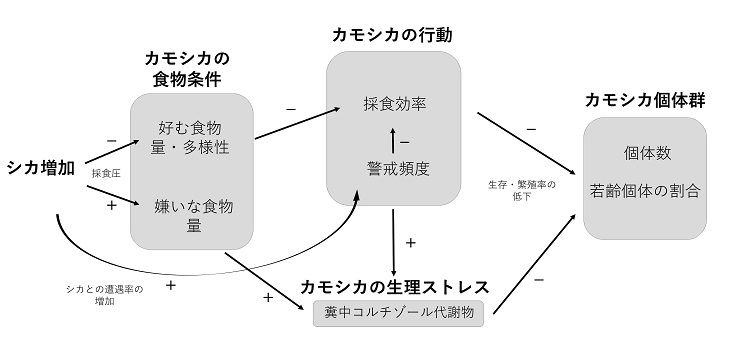
- It was suggested that in areas with high deer density, the amount and diversity of forb species preferred by serows decreases, serows become more likely to exhibit cautious behavior while foraging, their foraging efficiency decreases, their physiological stress increases, and serow populations decline and age.
- This is a very rare example in which direct evidence of interspecific competition has been shown in a native ungulate community that has supposedly coexisted for a long time. The change in the interspecific relationship between deer and Japanese serow may be the product of human modification of the ecosystem, such as the removal of apex predators (Japanese wolves) and reduced hunting pressure.
The results of this research were published in the online edition of the British zoology journal "Journal of Zoology" (April 25th).
Paper title: Competition between native ungulates: negative effects of sika deer (Cervus nippon) on foraging behavior, physiological stress, and population characteristics of Japanese serow (Capricornis crispus)
Author name: Hayato Takada*, Natsuki Tezuka, Risako Yano, Akane Washida, Tatsuya Hasegawa, Koji Yamazaki
URL: https://doi.org/10.1111/jzo.70023
summary
A joint research team led by Hayato Takada, Associate Professor of the National University Corporation Tokyo University of Agriculture and Technology Faculty of Agriculture Affiliated Wildlife Management Center, Risako Yano and Akane Washida of the Mt. Asama Antelope Research Group, Natsuki Tezuka (then a master's student) and Professor Koji Yamazaki of Tokyo University of Agriculture, and Tatsuya Hasegawa of the Mt. Fuji Science Research Institute in Yamanashi Prefecture discovered a sika deer (hereinafter referred to as "sika deer") in the alpine zone of Mt. Asama, Nagano Prefecture. We evaluated the effects of deer on food conditions, feeding behavior, physiological stress, and populations (Note 1) of Japanese antelope (hereinafter referred to as "antelopes"), and presented for the first time in the world direct evidence that an increase in deer leads to a decrease in antelope populations through interspecific competition. Interspecific competition in ungulate communities (Note 2) (Note 3) has been shown between livestock and native species, and between introduced species and native species, but this study is a rare example of interspecific competition in native ungulate communities that share evolutionary time, such as deer and antelope. Modifications to the ecosystem by humans, such as the removal of apex predators (two-horned wolves) and the reduction of hunting pressure, may have brought about changes in the interspecies relationship between deer and antelope, which should have coexisted stably.
Research Background
Interspecific competition is a relationship in which the existence of one species negatively affects the growth, survival, and reproduction of another species, and it affects the composition and population of animal species in nature, as well as the adaptive strategies of species such as behavior and morphology, so understanding the mechanism is an important issue in ecology. In communities of ungulates, which are large herbivores, interspecific competition has been reported between artificially introduced and native species, such as livestock and native species, introduced species and native species. On the other hand, it is generally known that native species that have built interspecies relationships over a long evolutionary period of time coexist by using different foods and living places. However, in recent years, it is known that the explosive increase of some species, such as some deer, has had a strong impact on the ecosystem. In such a situation, even in native communities, increased deer may have a negative impact on other ungulates through interspecific competition.
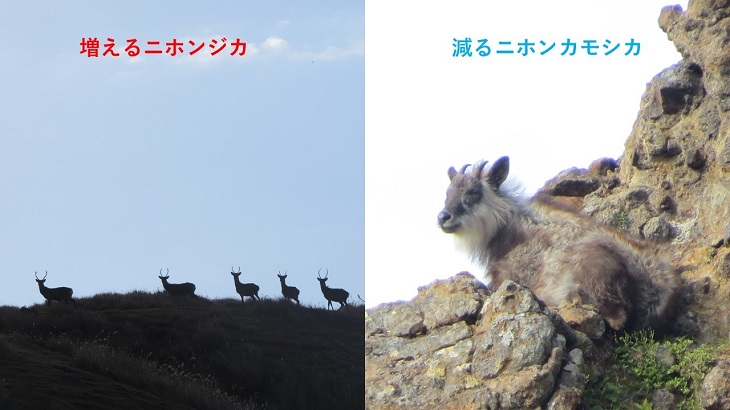
Both deer and antelope are native ungulates that represent Japan's ecosystem, but in recent years, rapid increases in deer and decline in antelope have been reported in several regions (Figure 1). It is possible that there is interspecific competition between these two species, but no studies have ever given direct evidence of this. Therefore, this study examined the existence of interspecific competition between deer and antelope by investigating food conditions, antelope feeding behavior, physiological stress, and population conditions in high-density and low-density areas of deer.
Research Structure
This research was carried out by a joint research team led by Hayato Takada of Tokyo University of Agriculture and Technology Faculty of Agriculture Affiliated Wildlife Management Center of the National University Corporation Associate Professor, Risako Yano and Akane Washida of the Asama Mountain Antelope Research Group, Professor Koji Yamazaki and Natsuki Tezuka of Tokyo University of Agriculture (then master's student), and Tatsuya Hasegawa of the Mt. Fuji Institute of Science in Yamanashi Prefecture. This research was supported by JSPS Grants-in-Aid for Scientific Research JP 22K14909 and JP 23KK0277.
Research Results
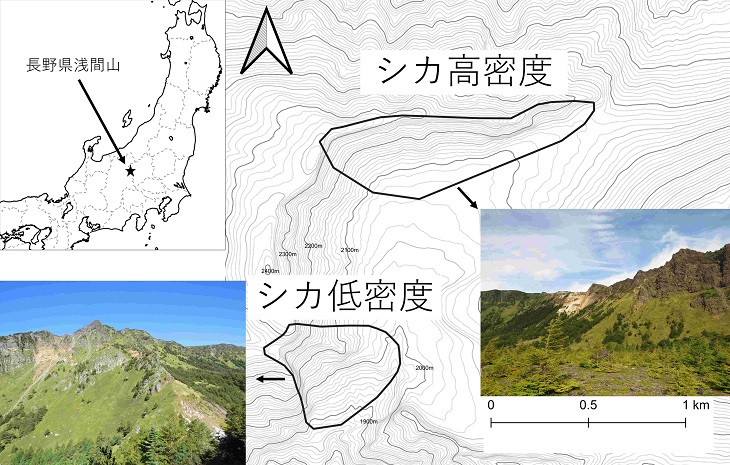
The survey was conducted in two areas of alpine grasslands (high-density deer area and low-density deer area) on Mt. Asama in Nagano Prefecture (Figure 2). The two areas are close to each other, only 1.3 km apart, and although the environmental conditions such as altitude, growing plants, and topography are similar, the deer densities are significantly different. It is known that the survival and reproduction of mountain ungulates are strongly influenced by the environmental conditions and feeding behavior from spring to autumn when plants grow. Therefore, the survey was conducted there from spring to autumn in 2021.
First, to investigate the amount and diversity of plants within the range of food for the two species, 20 survey plots (1m x 1m) were randomly set up in each area, and the biomass index (product of plant coverage and height) and the number of flowering broad-leaved herbaceous species were calculated. The results showed that the amount and diversity of broad-leaved herbaceous plants preferred by the Japanese serow were lower in high-density areas than in low-density areas. This suggests that the increased feeding pressure due to an increase in deer population worsens the food conditions for the Japanese serow.
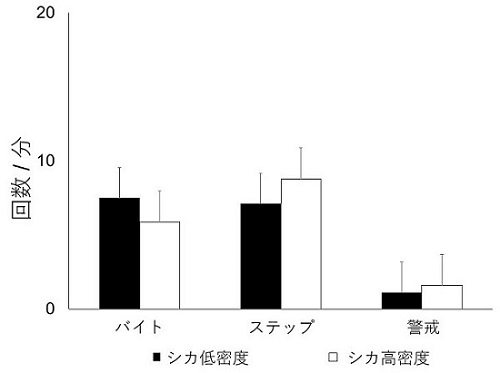
Next, to evaluate the frequency of alertness and feeding efficiency of the Japanese serow, we conducted direct observations of the feeding behavior of the Japanese serow for one week each month. The results showed that the Japanese serow were more likely to be alert while feeding, had slower feeding speeds (number of times they ate plants per minute: bites), and faster walking speeds (number of steps per minute: steps) in high-density deer areas compared to low-density deer areas (Figure 3). This suggests that an increase in deer density causes a decrease in the feeding efficiency of the Japanese serow. In high-density deer areas, the Japanese serow are more likely to encounter deer, so it is thought that they became more alert because they were concerned about the presence of deer. In addition, in high-density deer areas where there is little food that the Japanese serow prefer, their feeding speed decreased, and they had to walk around a lot to find food, combined with the time they spent on alertness for deer.
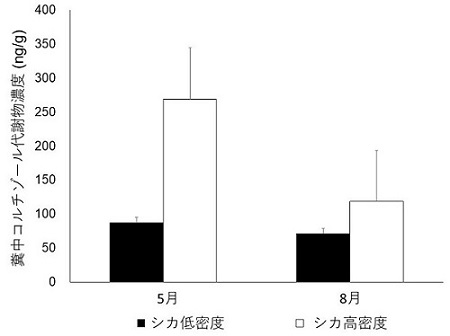
In addition, fresh serow feces were collected in May and August, and fecal cortisol metabolite concentrations, an indicator of physiological stress, were measured. The results showed that fecal cortisol metabolite concentrations were higher in high-density areas than in low-density areas (Figure 4). This suggests that deer density increases the physiological stress of serows. It is believed that poor food conditions and feeding efficiency in high-density areas, as well as the high frequency of encounters with deer, caused the increase in physiological stress in the serows. Furthermore, serows in high-density areas showed higher physiological stress in May than in August (Figure 4), which coincides with the time when deer seasonally migrate (Note 4) from low-altitude areas to the alpine study site. Therefore, they may have shown higher physiological stress in May, when they began to encounter deer again after not having been there between winter and early spring.
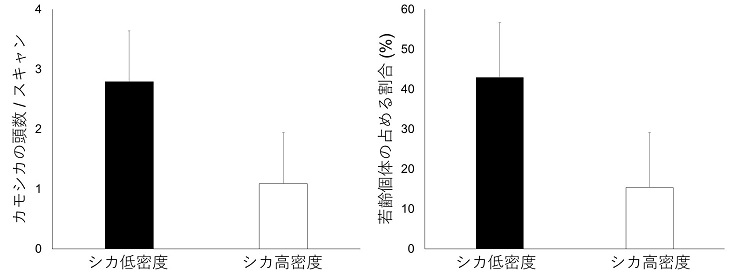
Finally, to compare the status of the serow population, the entire study area was scanned at 20-minute intervals from a fixed observation point with good visibility, and the number of serows and the proportion of young individuals were recorded. The results showed that fewer serows were found in high-density areas and that the proportion of young individuals was lower in these areas than in low-density areas (Figure 5). This suggests that high deer density causes a decline in the serow population and aging, i.e., a decrease in the growth rate. It is believed that the deterioration of food conditions and feeding efficiency in high-density deer areas, as well as high physiological stress levels, have a negative impact on the growth, survival, and reproduction of serows, resulting in a decline in the population and aging (Figure 6).
Future developments
This study is the first in the world to provide direct evidence that deer have a negative impact on serows through interspecific competition. This is a very rare example of interspecific competition in a native ungulate community that shares evolutionary time with deer and serows, and is thought to indicate how unbalanced the current mountain ecosystem in Japan is. One of the fundamental causes of the explosive increase in deer populations and their expansion is human modification of the ecosystem, such as the reduction in hunting pressure and the removal of apex predators, which may have changed the interspecific relationship between deer and serows, which should have coexisted relatively stably. However, this study has some limitations. In this study, we compared two areas with different deer densities, but to more precisely clarify the impact of deer, it is necessary to conduct long-term surveys in the same area and evaluate the impact of high deer density on serows. In addition, this study only showed the relationship between the two species in alpine grasslands. It is possible that the two species avoid interspecific competition by using resources differently in different habitats. Therefore, it is desirable to evaluate the interspecific relationship between the two species in more diverse habitats in the future.
Glossary
Note 1) A certain species of population that lives in a certain area
Note 2) A group of animals with hoofs. Includes even-toed ungulates (cattle and sheep) and odd-toed ungulates (horses and rhinoceroses).
*3) The population of all living species that inhabit a certain area.
Note 4) The movement of animals' habitats according to the seasons.
(Based on J Zool (2025) DOI10.1111/jzo.70023)
(Based on J Zool (2025) DOI 10.1111/jzo.70023)
◆Inquiries about research◆
Tokyo University of Agriculture and Technology Faculty of Agriculture Annex Wildlife Management Center
Associate Professor
Hayato Takada
TEL:042-367-5826
E-mail: takadah (please put @ here)go.tuat.ac.jp
◆ Inquiries about the press ◆
Tokyo University of Agriculture and Technology General Affairs Office Public Relations Office
Tel:042-367-5930
E-mail: koho2 (please put @ here)cc.tuat.ac.jp
Related links (opens in a new window)
- Tokyo University of Agriculture and Technology Associate Professor Hayato Takada Researcher Profile
- Tokyo University of Agriculture and Technology Associate Professor Hayato Takada Laboratory Website
- Hayato Takada Associate Professor belongs to Tokyo University of Agriculture and Technology Faculty of Agriculture Department of Ecoregion Science