
Deciding whether to fight offensively or defensively Unraveling the Mechanism of Struggle Strategy


Decide whether to fight offensively or defensively
Unraveling the Mechanism of Struggle Strategy
A research group led by Professor Tsuyoshi Shimmura of institute of Global Innovation Research, Tokyo University of Agriculture and Technology, in collaboration with Hiroshima University, Obihiro University of Agriculture and Veterinary Medicine, Uppsala University, and Columbia University, has elucidated the mechanisms of struggle strategies that determine whether to fight offensively or defensively. Aggressive behavior is an essential behavior for survival, especially in situations where struggle is unavoidable, especially in situations where struggle is unavoidable, the choice of struggle strategy such as biting, lunging, or defending is important, but the mechanism by which the difference in struggle strategy is not clarified. The international joint research group discovered that there are groups of chickens with very different fighting strategies, such as aggressive fighting groups and defensive fighting groups, and revealed that genomic mutations in genes related to neurodevelopment lead to gene expression and neuroendocrine changes in the brain, resulting in differences in fighting strategies. This study sheds light on how complex patterns of social behavior evolve and provides the first experimental evidence for classical game theory.
The results of this research were published in Molecular Biology and Evolution (January 9).
Title: Genomic and neurobiological bases of variation in fighting strategies in gamecocks
URL:https://doi.org/10.1093/molbev/msag007
Background
Aggressive behavior is an essential behavior for survival, especially in situations where struggle is unavoidable, the choice of struggle strategy such as biting, lunging, or defending is crucial. The importance of this struggle strategy is evident in the fact that 60 years ago, John Maynard = Smith (Note 1) predicted in the classical game theory of hawk (hawk) and pigeon (pigeon) game, in this theory, if there are hawks who are always aggressive and doves who are always defensive and fleeing, then the attack will continue to escalate with the hawk strategy alone, while on the other hand, Even with the dovish strategy alone, the animal population is not stable because the hawk always runs away when it invades. Game theory also suggests that populations with mixed fighting strategies of both hawks and pigeons are evolutionarily stable, and that genetic variation shapes their fighting strategies. However, the mechanism by which the struggle strategy differs has not been clarified, and experimental data to demonstrate game theory have not been reported so far.
Research Results
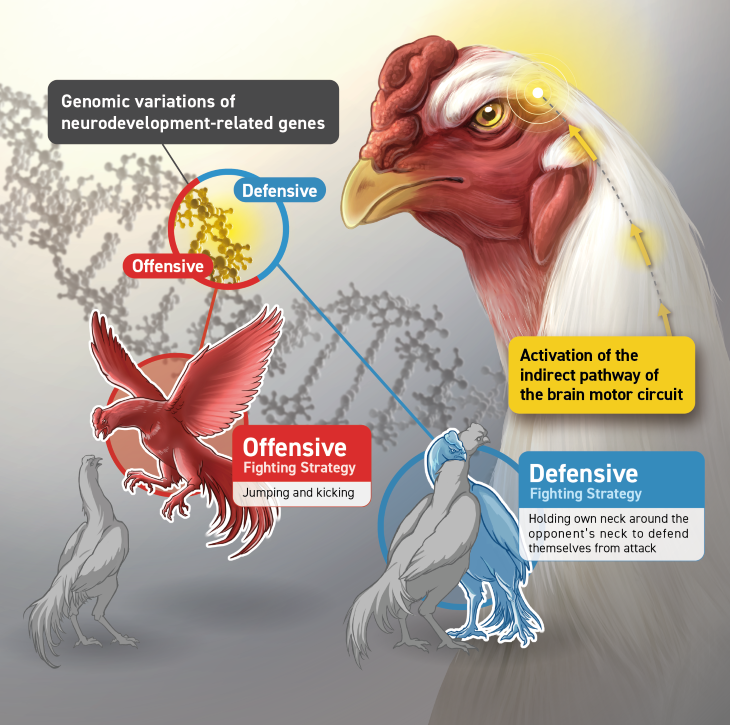
In this study, we first discovered that there is a group of Japanese chickens with very different fighting strategies within one breed of Japanese chicken (Daigun chicken). One group exhibits the typical chicken aggressive behavior of poking its head with its beak or jumping up and kicking in an aggressive strategy, while the other group shows a defensive strategy of avoiding the attack of another individual like a boxing clinch, clinging and wrapping its own neck around the neck of another individual to suppress the attack. Thus, the existence of a population with significantly different aggression strategies within a genetically closely related breed is an important model for clarifying the mechanism through comparative research.
Therefore, we first obtained whole-genome information (Note 2) from individuals from both groups and compared them, and extracted 15 candidate genes as genes that dominate the attack strategy. Five of the 15 genes are involved in neurodevelopment, and the FOXP1 gene is essential for the development of nerves in the brain, and its gene products are transcription factors (proteins that regulate gene expression) that have been shown to be involved in the regulation of motor circuits.
Next, when we obtained the diencephalon with many neuronal nuclei that control aggressive behavior from individuals in both populations, and comprehensively compared gene expression (Note 3), it became clear that genes related to neurodevelopment and neurotransmitter synthesis and release fluctuate. Among them, the PPP1R1B gene (also known as DARPP-32), which encodes a phosphorylated protein that controls dopamine signaling efficiency, was shown to be under the control of the FOXP1 gene, especially among individuals with aggressive and defensive strategies. When we analyzed the brain expression of PPP1R1B (a protein that is a PPP1R1B gene product) using immunohistochemistry, we found that the expression increased in the striatum of the basal ganglia, which controls movement, especially in individuals with defense strategies. Integrating these results with PPP1R1B functions suggests that defensive struggle strategies emerge when the motor circuits in the brain, especially the indirect pathways responsible for motor arrest, are activated, and the brakes of motor arrest are strongly applied during the struggle. This hypothesis was supported by the fact that in behavioral pharmacology trials administered drugs that artificially activate this indirect pathway, the frequency of fighting with aggressive strategies decreased, and conversely, the frequency of fighting with defensive strategies increased.
From the above, it becomes clear that struggle strategies are prescribed by genomic mutations and expression changes in genes associated with neurodevelopment, and that neuroendocrine changes in the brain's motor circuits further modulate these struggle strategies. Sixty years ago, John Maynard=Smith proposed game theory that predicted that strategies that included both aggressive individuals and those that avoided conflict and defended themselves would result in evolutionary stability. Now, 60 years later, this study, which uses the latest science and technology to clarify the molecular basis of struggle strategies, elucidates the molecular basis of how complex patterns of social behavior evolve, and provides the first empirical evidence for game theory.
Future developments
Genes such as FOXP1 are highly conserved, and the molecular mechanisms of the attack strategy revealed in this study may be widely preserved not only in other birds but also in vertebrates. In addition, the decline in aggression is considered the first event of domestication, and high aggression is also a major problem in the production of local chickens, which raise a large number of birds free-range in a large space. The identification of genes that define aggression will lead to the elucidation of the earliest events of domestication, and will also lead to the creation of new strains with low aggression through genomic breeding, which selects individuals using the gene sequence as a marker. Professor Shimmura's research group has further expanded this research and is currently promoting research related to elucidating the origins of domestication and the creation of new strains.
Research Structure
This research was carried out by Professor Tsuyoshi Shimmura, institute of Global Innovation Research, Tokyo University of Agriculture and Technology (Department of Biological Production, Faculty of Agriculture / Advanced Research Center for One Welfare Animal Symbiosis Informatics Research Area), Assistant Professor Takuma KurachI of Graduate School of Agriculture, and Yuki Matsuda, Kohei Shimura, Rikuto Maeda, Yohei Yamada, Yuki Higashiura and Nonoko N Shimura of Graduate School of Agriculture, Professor Masaki Tsuduki, Associate Professor Shin-Ichi Kawakami and Associate Professor Yoshiaki Nakamura, Hiroshima University, Associate Professor Tatsuhiko Goto, Obihiro University of Agriculture and Veterinary Medicine, Professor Leif Andersson, Fellow Nima Rafati, Fellow Mats Pettersson, and Associate Professor Andres Bendesky, Columbia University, USA. This research was supported by the Grants-in-Aid for Scientific Research (JP18K19266, JP19H03102, JP21H00339, JP21K19185, JP24H00541), the Distinguished Researcher Program of the Ministry of Education, Culture, Sports, Science and Technology, the Emergent Research Support Project (JPMJFR211D) of JST, the Tokyo University of Agriculture and Technology Convergence Research Support System (TAMAGO), and the Flag Shadow Society (Research Grant).
Glossary
Note 1) John Maynard = Smith
He was a British biologist who introduced mathematical theories such as game theory into the field of biology and a leading expert in evolutionary biology. As one of the most influential researchers in biology in the 20th century, he has won many international awards, including the Kyoto Prize (2001).
Note 2) Whole genome information
Here, DNA sequencing was performed using a next-generation sequencer to decode approximately 1.2 billion bases in chickens for each individual. Next, using population genome analysis, the sequences were compared with populations with aggressive strategies (23 individuals) and defensive strategies (22 individuals), and regions with many different sequences were identified, and genes located there were extracted as candidate genes.
Note 3) Gene expression
Here, RNA sequencing was performed using a next-generation sequencer to measure the expression of approximately 20,000 genes in chickens (5 individuals each, 10 individuals in total). The expression levels were compared between populations with offensive and defensive strategies, and genes with different expression levels were extracted.
◆研究に関する問い合わせ◆
東京農工大学大学院グローバルイノベーション研究院
教授
新村 毅(しんむら つよし)
TEL:042-367-5856
E-mail:shimmura(ここに@を入れてください)go.tuat.ac.jp
Related links (opens in a new window)
- Tokyo University of Agriculture and Technology Professor Tsuyoshi Shimmura Researcher Profile
- Tokyo University of Agriculture and Technology Professor Tsuyoshi Shimmura laboratory website
- Professor Tsuyoshi Shimmura belongs to Tokyo University of Agriculture and Technology Institute of Global Innovation Research