
Development of High-Speed Magnetic Tweezers Controllable at 1/1000 Second — Successful Measurement of Mechanical Responses Inside Living Cells —


Development of High-Speed Magnetic Tweezers Controllable at 1/1000 Second
— Successful Measurement of Mechanical Responses Inside Living Cells —
A research group led by Mr. Akinori Miyamoto, PhD student at the Graduate School of Engineering, Tokyo University of Agriculture and Technology (TUAT), Associate Professor Yoshihiro Murayama of the Division of Advanced Applied Physics, Institute of Engineering, TUAT, Mr. Ryota Orii, PhD student at the Graduate School of NanoBioScience, Yokohama City University (YCU), and Associate Professor Hirokazu Tanimoto of the same graduate school, has developed high-speed magnetic tweezers capable of controlling magnetic field strength with millisecond precision (1/1000 second), and successfully measured mechanical responses inside living cells. By adopting a digital control scheme, magnetic fields can be controlled more simply than with conventional methods. This technology is expected to be widely applied not only to intracellular mechanical measurements, but also to the development and evaluation of soft materials, including biomaterials.
This research was published online in Applied Physics Letters on February 25.
Title: High-speed intracellular magnetic tweezers with digital PID controller
URL: https://doi.org/10.1063/5.0306107
Background :
When a force is applied, materials may exhibit elastic properties, like a spring that stretches and contracts, or viscous properties, like water that flows. Materials possessing both properties are referred to as viscoelastic. The viscoelasticity of cells and cell nuclei is closely related to cell differentiation, tumor formation, and regulation of gene expression. Various experimental techniques have been developed to measure mechanical responses associated with viscoelasticity. Since the intracellular environment has a complex structure, measurements must be performed in the force range of 1–1000 piconewtons (Note 1). A common approach is to introduce magnetic beads with diameters of several micrometers into cells and apply forces using electromagnets, known as magnetic tweezers. Precise control of the magnetic field is required, but conventional analog control systems demand advanced knowledge and skills. In this study, we adopted a digital control system using a general-purpose controller, achieving simple and high-speed magnetic field control with millisecond precision.
Research Team :
This study was conducted collaboratively by Mr. Akinori Miyamoto (TUAT), Associate Professor Yoshihiro Murayama (TUAT), Mr. Ryota Orii (YCU), and Associate Professor Hirokazu Tanimoto (YCU). This work was supported in part by JSPS KAKENHI (JP23KJ0865, JP22K19277, JP22H05171, JP24K06975), JST PRESTO (JPMJPR20E9), and the SPRING program.
Research Results :
Using a general-purpose digital controller incorporating an FPGA (Field Programmable Gate Array), we developed magnetic tweezers suitable for microscopic observation of living cells. We achieved high-speed magnetic field control with millisecond precision and suppressed thermal deformation of the magnetic core caused by Joule heating. By applying constant forces to magnetic beads introduced into living cells, we successfully obtained viscoelastic responses across four orders of magnitude in time (1 ms to 10 s) in a single measurement. This technique prevents cellular damage caused by probe contact and enables detection of soft structural changes inside cells that cannot be observed through repeated measurements. It is also expected to reveal the effects of millisecond-scale reactions involving molecular motors and the cytoskeleton on viscoelastic properties.
Future Prospects :
Because the developed digital high-speed magnetic tweezers do not require advanced knowledge of electronics or control engineering, they are expected to find broad applications in cell biology, soft matter physics, and the development and evaluation of functional and biomaterials.
Glossary :
Note 1) Piconewton :
The newton is the SI unit of force; approximately 1 N corresponds to the gravitational force acting on a 100 g mass. One piconewton is 10-12 newtons.
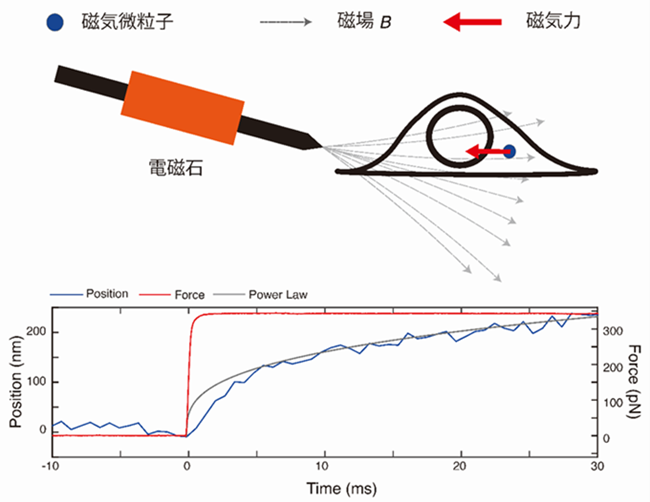
(Figure partially modified from doi:10.1063/5.0306107.)
Contact :
Yoshihiro Murayama, PhD
Associate Professor, Division of Advanced Applied Physics, Institute of Engineering, Tokyo University of Agriculture and Technology
TEL/FAX:+81-42-388-7107
E-mail: ymura (put @ here)cc.tuat.ac.jp
Hirokazu Tanimoto, PhD
Associate Professor, Graduate School of NanoBioScience Yokohama City University
TEL/FAX:+81-45-787-2166
E-mail: tanimoto (put @ here)yokohama-cu.ac.jp
Media Inquiries :
Public Relations Office, Tokyo University of Agriculture and Technology
E-mail: koho2 (put @ here)cc.tuat.ac.jp
Research and Industry Collaboration Promotion Division, Yokohama City University
E-mail: kenkyu-koho (put @ here)yokohama-cu.ac.jp
Related links (opens in a new window)
- Tokyo University of Agriculture and Technology Associate Professor Researcher Profile
- Tokyo University of Agriculture and Technology Associate Professor Laboratory Website
- Associate Professor is a member of Department of Biomedical Engineering Faculty of Engineering Tokyo University of Agriculture and Technology and Technology.