
The true nature of the "impact force" exerted by droplets on objects is elucidated. First demonstration of the transition in which "droplets" behave like "solid spheres" on soft materials! ~New guidelines for next-generation 3D bioprinting and advanced design of coating and cleaning~


The true nature of the "impact force" exerted by droplets on objects is elucidated.
First demonstration of the transition in which "droplets" behave like "solid spheres" on soft materials!
~New guidelines for next-generation 3D bioprinting and advanced design of coating and cleaning~
Tokyo University of Agriculture and Technology Professor Yoshiyuki Tagawa and his team at the Graduate School of Institute of Engineering Division of Advanced Mechanical Systems Engineering have continuously shifted the maximum collision force of droplets hitting soft substrates from the inertial rule law Note 1 that appears at low viscosity and high speed to the Hertz rule Note 2, which is known for the collision of solid spheres (crossover Note 3) It was the first in the world to demonstrate that it can be done. For the first time, we introduced a unified index Z *5 that directly measures the stress distribution and collision force inside the substrate using our proprietary high-speed photoelastic tomography *4, and summarizes the viscosity and inertia of droplets and the elasticity of the substrate. As a result, we showed that the data of various conditions overlapped with a single master curveNote 6, and presented a design map that estimates the collision force in advance using a mathematical formula. This will lead to a deeper academic understanding of fluid-solid interactions, as well as a unified "yardstick" that can control adhesion and spread as intended while reducing substrate damage in inkjet, electronic material application, lotion mist, cleaning, bioprinting, food printing, wind turbine blades, and various coatings.
The results of this research will be published in the scientific journal Nature Communications (January 28th issue).
Press embargo lifted: January 28, 2026 (Wednesday), 7:00 PM (Japan time)
Paper title: Scaling crossover in droplet impact force on elastic substrates
Scaling crossover in droplet impact forces on elastic substrates
Authors: Yuto Yokoyama, Hirokazu Maruoka, Kaie Matsunuma, Yoshiyuki Tagawa
DOI: 10.1038/s41467-025-67790-6
URL: https://www.nature.com/articles/s41467-025-67790-6
Current situation
Droplet collision is a phenomenon that is widely involved in inkjet and electronic material application, cooling and washing, raindrop erosion, bioprinting, and other familiar products to cutting-edge manufacturing. Until now, changes in shape, such as "how much it spreads" and "how much contact" have been investigated in detail, but "how much force is applied to the substrate" at the moment of collision has not been fully organized, especially with soft materials. This is because in soft materials, both the droplets and the substrate are deformed at the same time, making the transmission of force complex and difficult to measure accurately. As an effect of the collision force of the droplets, for example, if the spray force is too strong, it will cause extra damage and unevenness on the soft receiving side such as paper, polymer film, and skin, and if it is too weak, it will cause insufficient adhesion and printing defects. If the collision force can be predicted in advance, nozzle speed, liquid viscosity, and substrate elasticity can be optimized with minimal prototyping, and designs that are directly related to "longevity, safety, and comfort" are directly related to printing bleeding, comfortable skin care application, cleaning without damaging coatings, and reducing cell damage in bioprinting.
Research Structure
This research was conducted by Prof. Yoshiyuki Tagawa (Tokyo University of Agriculture and Technology Institute of Engineering Division of Advanced Mechanical Systems Engineering), Yuto Yokoyama (Graduate School of Engineering Ph.D. Fellow, Okinawa Institute of Science and Technology Graduate University), Hirokazu Maruoka (Graduate School of Agriculture Ph.D. Graduate School, Okinawa Institute of Science and Technology Postdoctoral Scholar), and Kaie Matsunuma (Graduate School of Engineering Master's students).
This research was supported by the JSPS Grant-in-Aid for Scientific Research JP24H00289, JP24KJ2176, JP22KJ1239, and JST's Strategic Creative Research Promotion Project "New Fluid Science with Known Forces" (JPMJPR21O5).
Research results
In this study, we measured in detail the maximum impact force of a droplet impacting a soft substrate and demonstrated that its scaling (a law that applies across scales) crosses over from the inertia-dominated law to Hertz's law. Understanding the scaling allows us to compare and design on the same scale even when materials, speeds, and sizes are different, enabling us to estimate upper limit forces and evaluate damage risks early, thereby reducing the need for rework in prototyping and verification, and saving on-site costs and time. From this perspective, this result can be considered an important one, demonstrating scaling on soft substrates, which had not been fully understood until now.
Using our proprietary high-speed photoelastic tomography technology, we visualized the stress distribution that spreads over time within the substrate at the moment of impact, successfully directly measuring the droplet impact force acting on a soft substrate, something that was difficult to achieve with conventional load meters (see bottom panel of Figure 1). Furthermore, we introduced a unified index, Z, that integrates the droplet's viscosity, inertia, and substrate elasticity, and demonstrated that the maximum impact force data obtained under multiple conditions could be superimposed on a single master curve (Figure 2). This demonstrates that the crossover from the inertia-dominated law to Hertz's law can be understood with a single law. This demonstrates that in addition to the conventional understanding that "the higher the viscosity, the more Hertz's law appears," Z can also consistently explain the non-intuitive region where "Hertz's law appears even with viscosity, provided the substrate is sufficiently soft and the impact is sufficiently fast." In other words, Z serves as a "design map" that identifies in advance which conditions fall into which law, enabling early identification of risks and optimal conditions in areas that are often overlooked.
Future developments
High-speed droplet impact design on soft materials:
This enables "numerical design" of impact forces on soft substrates (skin, coatings, gels, etc.) in inkjet printing, electronic material application, skin contact with lotion mist, spray cleaning of home appliances and kitchens, bioprinting, etc. By evaluating the substrate elasticity and spray conditions (speed and viscosity) in advance using the unified index Z, it is possible to design adhesion, patterning, and tactile sensations as intended while minimizing damage.
Industrial applications:
This provides a new standard for the integrated evaluation of substrate elasticity, impact inertia, and droplet viscosity in the evaluation of damage caused by droplet impacts, such as raindrop erosion on wind turbine blades and exterior coatings, and paint durability in the automotive and aviation fields. Mapping the combination of material softness and structure with impact conditions in Z will improve the accuracy of predictions of erosion and fatigue progression, contributing to longer-life designs.
Contribution to academic research:
- Presentation of the unified index Z and threshold Zc: We quantified the transition point between the law of inertia and Hertz's law, providing a basis for comparing future theories, numerical values, and experiments in the same coordinate system.
- Master curve H=Φ(Z): Provided a prediction curve for the maximum impact force and served as a benchmark for model validation and improvement.
Measurement platform: We established a method based on non-contact, field measurements called high-speed photoelastic tomography, and presented a method that can be extended to research on fluid-solid interactions and biological soft matter.
International collaborative research and development:
In the future, we plan to expand the fields of application through international collaborative research and to proceed with the standardization of equipment, data disclosure, and design guidelines.
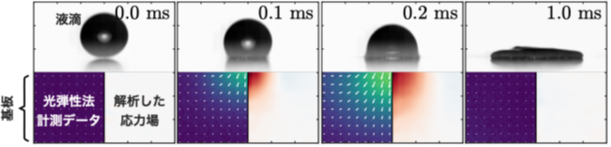
Figure 1: Measurement of the stress field within a substrate upon droplet impact: Shows a droplet impacting a soft substrate (top of each panel), photoelasticity measurement data captured with a polarization camera (bottom left of each panel), and the stress field reconstructed from the analysis (bottom right of each panel) over time (units: milliseconds, 1/1000 of a second). Approximately 0.1 ms after the droplet impact, stress spreads within the substrate, and by 1.0 ms, when the droplet has flattened, the stress has almost disappeared, as can be seen from the photoelasticity measurement data (stress shown in yellow-green) and the analysis results (stress shown in red). (Created based on Yokoyama et al., Nature Communications, 2025)
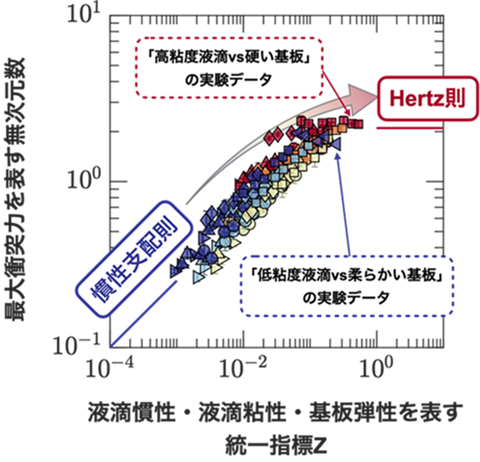
Figure 2: Transition of the scaling law for maximum impact force using the unified index Z: By using the unified index Z, which encompasses droplet viscosity, droplet inertia, and substrate elasticity, for maximum impact force data obtained under a variety of experimental conditions, the continuous transition from the inertia-dominated law to Hertz's law can be understood with a single law (master curve). "When a low-viscosity droplet impacts a soft substrate" shows the same behavior as "when a high-viscosity droplet impacts a hard substrate." (Based on Yokoyama et al., Nature Communications, 2025)
Glossary
Note 1 Inertia governing law
This is a scaling law that holds when the effect of inertia, which corresponds to "mass x velocity squared," is dominant over the viscosity and surface tension of the droplet. It often appears when low-viscosity droplets collide at high speed.
Note 2 Hertz's Law
This theory describes the relationship between contact area, force, and deformation when a solid sphere collides with an elastic body. It has been used primarily in contact problems between solids, but this research shows that a similar scaling also appears in the impact force of a liquid droplet.
Note 3 Crossover
A smooth transition (switching) of the governing physical laws and behaviors from one to the other as certain conditions change. In this study, this refers to the phenomenon in which the scaling of collision forces shifts from the inertial law to Hertz's law.
Note 4 High-speed photoelastic tomography
This measurement technique utilizes the photoelastic effect, which is the phenomenon in which the way light passes changes due to stress generated inside a transparent elastic material, and reconstructs the internal stress distribution over time by combining a high-speed camera and a polarization optical system. It can visualize the internal force distribution without directly touching the object.
Note 5 unified index Z
A unitless index created by combining physical quantities with different units (length, time, weight, etc.). In this study, a unified index Z was introduced that combines the viscosity and inertia of the droplet and the elasticity of the substrate, and was used to organize and predict a large number of experimental conditions all at once.
Note 6 Master Curve
The phenomenon in which data obtained under various conditions are properly normalized to fit onto a common curve. This is used to indicate universal behavior.
◆Research-related inquiries◆
Tokyo University of Agriculture and Technology University of Agriculture and Technology Institute of Engineering
Professor, Division of Advanced Mechanical Systems Engineering
Yoshiyuki Tagawa
TEL/FAX: 042-388-7407
E-mail: tagawayo (insert @ here) cc.tuat.ac.jp
◆Inquiries about the press◆
Tokyo University of Agriculture and Technology General Affairs Office Public Relations Office
TEL:042-367-5930
E-mail: koho2 (put @ here)cc.tuat.ac.jp
Okinawa Institute of Science and Technology Graduate University Media Collaboration Section
TEL:098-982-3447
E-mail:media (put @ here)oist.jp
Japan Science and Technology Agency Public Relations Division
Tel:03-5214-8404
E-mail: jstkoho (put @ here)u-shizuoka-ken.ac.jp
◆Inquiries about the press◆
Japan Science and Technology Agency Strategy Research Advancement Division Green Innovation Group
Yusuke Ando
TEL:03-3512-3526
E-mail: presto (put @ here)jst.go.jp
Related links (opens in a new window)
- Tokyo University of Agriculture and Technology and Technology Professor Yoshiyuki Tagawa Researcher Profile
- Tokyo University of Agriculture and Technology and Technology Professor Yoshiyuki Tagawa Laboratory Website
- Professor Yoshiyuki Tagawa is a member of Department of Mechanical Systems Engineering Tokyo University of Agriculture and Technology Faculty of Engineering.