
Ultrasound detects qualitative changes in bone due to osteoporosis - Confirmation of decreased piezoelectric signal in rat femur using acoustically induced electromagnetic method -


Ultrasound can detect qualitative changes in bone caused by osteoporosis
- Confirmation of decreased piezoelectric signal in rat femur using acoustically induced electromagnetic method -
Key points of this study
- We used the ASEM method, which detects weak electrical polarization (piezoelectric signals) generated in bone collagen by ultrasound irradiation, to detect changes associated with osteoporosis in rat femurs.
- We verified this using two types of rat osteoporosis models and confirmed that piezoelectric signals also decreased in the femur where bone mass was reduced.
- This result demonstrates the potential of applying the ASEM method to a new non-invasive diagnostic technique for evaluating "bone quality," which is related to collagen and is difficult to capture solely by bone density.
Overview
Tokyo University of Agriculture and Technology A research group consisting of Professor Kenji Ikushima of Graduate School Institute of Engineering Division of Biomedical Engineering (President and CEO of ASEMtech Inc.), Researcher Yoshitsugu Kojima of Japan Sigmax Inc., Nobuo Niimi, Vice President of ASEMtech Inc., Yutaka Yabe of Tohoku University Graduate School of Medicine, and Yoshihiro Hagiwara of the same graduate school and Anylom Inc., used acoustically stimulated electromagnetic (ASEM) method, which detects weak electrical polarization (piezoelectric signals) generated in bone by ultrasound irradiation, to capture changes associated with osteoporosis in the femur of rats. In areas where bone mass loss was confirmed by microCT, the piezoelectric signal was significantly lower than on the healthy side. This achievement serves as the foundation for technology that non-invasively evaluates qualitative bone information different from bone density, and is expected to contribute to the advancement of fracture risk assessment in the future.
The results of this research were published in "Ultrasound in Medicine & Biology" (dated September 22, 2026).
Research background
It is estimated that there are approximately 15.9 million people with osteoporosis in Japan, making fracture prevention a crucial issue in our super-aging society. According to the 2022 National Survey on Living Conditions, "fractures and falls" accounted for 13.9% of the causes of needing support or care, ranking third after dementia and cerebrovascular disease.
Bone strength is determined by both "bone density," which represents bone mineral content, and "bone quality" (Note 2), which consists of the state of collagen fibers and microstructure. Currently, X-ray bone density measurement is widely used for diagnosing osteoporosis, but a simple and non-invasive method for evaluating bone quality, which is related to fracture risk, has not yet been sufficiently established. Collagen in bone has piezoelectric properties, which cause electrical polarization when force is applied. The research group investigated whether changes in bone quality could be detected by utilizing this property.
Research results
ASEM is a technique that generates electrical polarization (piezoelectric signal) from the piezoelectricity of bone collagen by irradiating it with ultrasound, and then detects this weak electrical signal with a resonant antenna. Without attaching electrodes to the bone, the signal distribution can be imaged by scanning the ultrasound irradiation position. The measurement principle is shown in Figure 1.
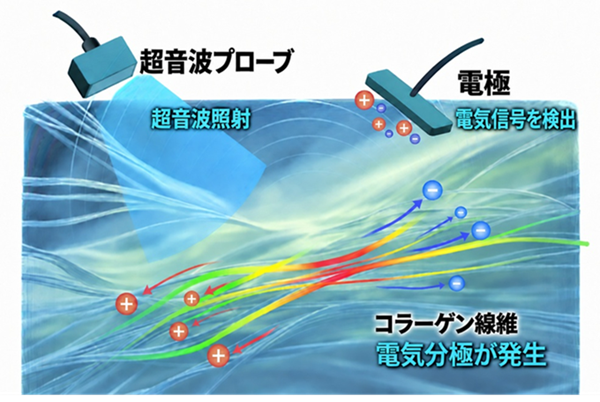
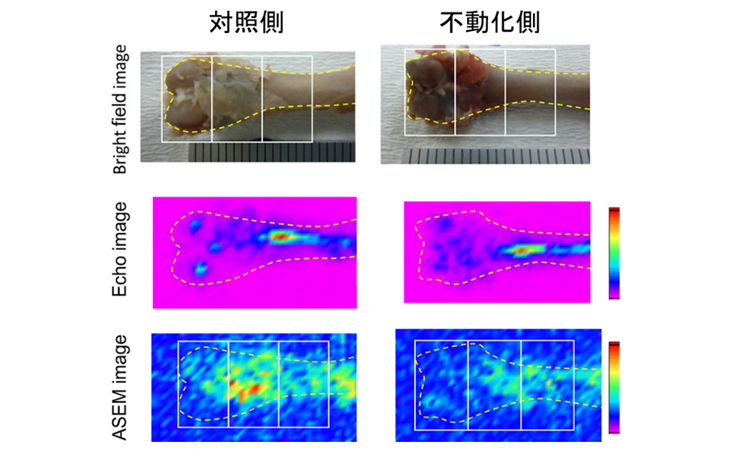
Figure 2: Experimental results of the femur on the control side (left) and the immobilized side (right) in a knee joint immobilization model. From top to bottom: external photograph, ultrasound image, and ASEM image (Source: Partially translated from Fig. 6(a) in "Publication Information" below. © 2026 The Authors. CC BY 4.0).
In this study, we used a diabetic model and a knee immobilization model in which one knee joint of rats was immobilized for 12 weeks. Micro-CT was used to confirm osteoporotic changes, and ASEM signals were measured on the posterior surface of the femur. Significant signal reductions were observed in the metaphysis and diaphysis in the diabetic model, and in the distal epiphysis and metaphysis in the knee immobilization model.
While conventional ultrasound images did not clearly show a difference between the control and immobilized sides, ASEM images confirmed a decrease in signal intensity on the immobilized side (Figure 2). Furthermore, in a diabetic model, a decrease in signal intensity in the metaphysis was observed even after demineralization. These results suggest that the ASEM method has the potential to detect changes in bone quality related to bone collagen.
Future developments
In a super-aging society, it is crucial to prevent fractures caused by osteoporosis and protect the independent living and healthy lifespan of the elderly. Osteoporosis often has few noticeable symptoms and is only discovered after a fracture occurs, so there is a need for tests that can identify fracture risk early and lead to prevention and treatment.
The ASEM method may allow us to evaluate bone quality related to collagen, which is difficult to capture with conventional bone density tests, potentially enabling a more multifaceted assessment of fracture risk. In the future, we aim to clarify the relationship between ASEM signals and collagen status and bone strength, as well as develop devices and analysis methods that can stably measure these signals in vivo, with the goal of applying them to humans.
Acknowledgments
This research was supported by JSPS KAKENHI Grants JP18K09092 and JP22K19912.
Glossary
Note 1) Acoustically stimulated electromagnetic method (ASEM method)
A method for detecting and imaging electric and magnetic polarizations induced within materials by acoustic waves using a resonant antenna.In this study, electric polarization arising from the piezoelectric properties of bone collagen was measured.
Note 2) Bone quality
Among the factors that determine bone strength, bone properties cannot be fully expressed by bone density alone. These include the amount, orientation, structure, and cross-linking of collagen fibers, as well as the microstructure of the bone.
Paper information
Title: Detection of Osteoporotic Changes in Rat Femoral Bone Using the Acoustically Stimulated Electromagnetic (ASEM) Method
Authors: Yoshitsugu Kojima, Nobuo Niimi, Kenji Ikushima, Yutaka Yabe, Yoshihiro Hagiwara
Publication: Ultrasound in Medicine & Biology
Publication date: September 22, 2026
DOI: 10.1016/j.ultrasmedbio.2026.08.019
URL: https://www.umbjournal.org/article/S0301-5629(26)00343-1/fulltext
◆ Research Inquiries ◆
Tokyo University of Agriculture and Technology Graduate School Institute of Engineering Division of Biomedical Engineering
Professor Kenji Ikushima
E-mail: ikushima (please include @ here)cc.tuat.ac.jp
Related links (opens in a new window)
- Tokyo University of Agriculture and Technology and Technology Professor Kenji Ikushima Researcher Profile
- Tokyo University of Agriculture and Technology and Technology Professor Kenji Ikushima Laboratory Website
- Professor Kenji Ikushima is a member of Department of Biomedical Engineering Faculty of Engineering Tokyo University of Agriculture and Technology and Technology.