
How the Flow of Electricity in Liquids Changes the Appearance of Plasma — New Insights on Controlling Discharge Conditions from the Type and Arrangement of Liquids —


How the Flow of Electricity in Liquids Changes the Appearance of Plasma
— New Insights on Controlling Discharge Conditions from the Type and Arrangement of Liquids —
Key points of this study
- The discharge state of plasma varies greatly depending on how readily electricity flows through the liquid (its conductivity).
- Liquids that readily conduct electricity transition to continuous discharge, while liquids containing low-conductance ultrapure water exhibit a different state of repeated short discharges.
- Not only the liquid's conductivity but also the arrangement on the cathode and anode sides affect the characteristics of current and light emission.
Overview
A research group consisting of Ayano Goto, an Integrated Doctoral Program student in the Graduate School of Bio-Applications and Systems Engineering; Ryosuke Watanabe, a doctoral student in the Graduate School of Engineering; Kazuyo Ito, Assistant Professor in the Division of Biomedical Engineering; Godai Miyaji, Professor in the Division of Applied Physics and Chemical Engineering; and Daisuke Yoshino, Professor in the Division of Biomedical Engineering, at Tokyo University of Agriculture and Technology used an experimental system in which two liquids were placed facing each other and plasmaNote1)was generated in a small air gap between them. They clarified that the ease of electrical flow conductivityNote 2) and its placement on the cathode and anode sides greatly affect the discharge state of the formed plasma. Until now, research at the interface between plasma and liquids has mainly focused on "how plasma affects liquids," but this study demonstrated that the properties and arrangement of the liquid side also influence the formation of plasma itself. Furthermore, different discharge states are formed depending on the conditions of the liquid, which in turn causes differences in luminescence, temperature rise, and changes in chemical species and pH within the liquid after discharge. This achievement provides fundamental knowledge for controlling phenomena occurring at the plasma-liquid interface by utilizing the properties and configurations of liquids, and is expected to lead to applications in water treatment, biomedical care, and chemical analysis.
The results of this research were published in the international journal Plasma Processes and Polymers (dated September 4, 2026).
Background of the Research
Technologies that allow plasma to come into contact with liquids are being researched for applications in various fields such as water treatment, sterilization, medical and biological, and chemical analysis. Because plasma comes into contact with liquids produces highly reactive chemical species, many studies have examined phenomena mainly from the perspective of "how plasma affects liquids." On the other hand, it has not been fully understood how conductivity—which indicates how easily a liquid can flow electricity—or the arrangement of the liquid relative to the electrodes affects the formation of plasma itself.
Therefore, the research group constructed an experimental system by placing metal electrodes inside each liquid and creating a 2mm air layer between the two opposing liquid surfaces (Figure 1). Using this experimental system, they systematically investigated how changing the liquid's conductivity and its arrangement on the cathode and anode sides influenced the plasma discharge state formed by liquid-side conditions.
Research Results
In this study, we examined the chemical changes in current, luminescence, high-speed imaging, temperature, and the chemical changes in the liquid after discharge, by varying the combination of phosphate-buffered saline (PBS)Note 3)that easily conducts electricity and ultrapure water (UPW) Note 4), which hardly conducts electricity, or by changing the arrangement on the cathode and anode sides. As a result, it was found that different discharge states are formed depending on the liquid's conductivity and configuration, and accordingly, electrical, optical, thermal, and chemical characteristics also change. The main results are as follows.
1. Different discharge states are formed depending on the conductivity of the liquid.
When PBS is placed on both sides to facilitate conduct, the transition shifts from spark discharge Note 5) at the start of discharge to a persistent DC glow dischargeNote 6)(Figure 2 left). On the other hand, when UPWs that are difficult to conduct electricity are present on one or both sides, sustained DC current does not occur, resulting in a state similar to dielectric barrier discharge (DBD) Note 7)where short-duration current pulses are repeated (Figure 2 right). Furthermore, even in sodium chloride (NaCl) aqueous solutions, which have a different chemical composition from PBS, a transition from similar spark discharge to DC glow discharge was confirmed when conductivity was nearly the same as PBS, demonstrating that not only the chemical composition of the liquid but also conductivity is an important factor determining the discharge state.
2. Current and emission change depending on the liquid placement on the cathode and anode sides.
When PBS and UPW were used separately, even if the type of liquid was the same, the way the current pulse was generated and the light spread changed depending on which was placed on the cathode or anode side. In particular, the orange emission derived from sodium and other substances in PBS was concentrated near the liquid surface when PBS was placed on the cathode side, whereas when placed on the anode side, it was distributed more widely in the discharge space. From these results, it was shown that not only conductivity but also whether the liquid is placed on the cathode or anode side influences the electrical and optical characteristics of plasma.
3. Differences in discharge state are reflected in heat and liquids after discharge
In sustained discharge formed by placing PBS on both sides, significant temperature increases occurred near the gas or liquid surface, whereas under conditions containing UPW, significant temperature increases in the gas phase were not observed. Furthermore, after discharge, when PBS was placed on both sides, the concentration and pH of chemical species such as hydrogen peroxide changed significantly compared with conditions containing UPW. In other words, differences in the selected discharge state depending on the properties and arrangement of the liquid corresponded not only to light emission and current but also to thermal and chemical responses.
Future Developments
This study revealed that at the interface between plasma and liquid, not only does the liquid react to the plasma, but the electrical properties and configuration of the liquid itself are crucial factors determining what kind of plasma is formed.
Going forward, by quantitatively investigating the electric field and electron states within plasma, the distribution of reactive chemical species, and the tiny droplets and airflow generated from the liquid surface, we will further clarify the physical mechanisms by which the properties and arrangement of liquids determine the discharge state. In the future, by selecting the properties and configurations of liquids according to their objectives, it is expected that plasma states and plasma-liquid reactions can be controlled, leading to the design of plasma technologies suitable for water treatment, sterilization, medical and biological, and chemical analysis.
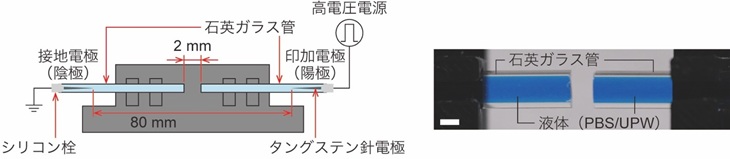
Figure 1: Experimental system generating plasma between two liquid surfaces.Two liquid-filled glass tubes were positioned facing each other, and a 2 mm air layer was provided between the liquid surfaces. The metal electrodes were each arranged inside the liquid, and the plasma state was compared by varying the type of liquid and the arrangement on the cathode and anode sides. The scale bar indicates 2 mm.
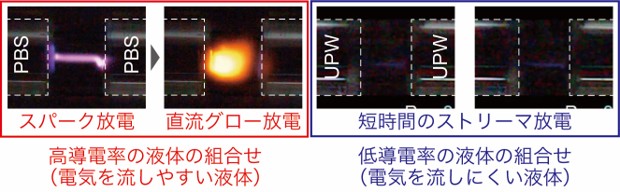
Figure 2: Plasma discharge states varying depending on the conductivity of the liquid.When liquid that easily conducts electricity is placed on both sides, the discharge transitions from the spark discharge at the start to a sustained DC glow discharge (left). On the other hand, when the liquid is difficult to conduct electricity, the discharge does not progress to sustained discharge, and short-term streamer discharges repeatedly occur (right). The image shows plasma emission captured with a high-speed camera.
Acknowledgments
Part of this research was conducted with support from the Japan Science and Technology Agency (JST) Emerging Research Support Program (FOREST, Project No.: JPMJFR222S).
Glossary
Note 1) Plasma
A state in which some atoms or molecules that make up a gas have split into electrons and ions. It is also found inside lightning and fluorescent lamps. In this study, plasma was generated in the air between two opposing liquid surfaces.
Note 2) Conductivity
An indicator indicating how easily a substance conducts electricity. A higher conductivity means it is easier to conduct electricity.
Note 3) Phosphate-buffered saline (PBS)
An aqueous solution containing multiple ions and maintaining a certain pH range. It is widely used in experiments in the biological and medical fields.
Note 4) Ultrapure Water (UPW)
Water with impurities such as ions removed to extremely low concentrations. The UPW used in this study is a liquid that conducts electricity much less easily compared to PBS.
Note 5) Spark discharge
Discharge occurs when the insulation of the gas is broken, causing a large current to flow in a short time.
Note 6) DC Glow Discharge
A type of gas discharge in which current flows relatively steadily
Note 7) Dielectric Barrier Discharge (DBD)
It is one of the discharge methods in which short-term discharges occur repeatedly. In this study, under conditions including UPW, no sustained DC current was observed, and similar current and emission behavior were observed.
Paper Information
Title: Discharge regime selection governed by liquid conductivity and configuration in a liquid–gas–liquid plasma system
Authors: Ayano Goto, Ryosuke Watanabe, Kazuyo Ito, Godai Miyaji, Daisuke Yoshino*
Published in: Plasma Processes and Polymers
Date posted: September 3, 2026
URL:http://dx.doi.org/10.1002/ppap.70251
◆本研究に関する問い合わせ先◆
東京農工大学大学院工学研究院生体医用工学部門
教授 吉野 大輔(よしの だいすけ)
TEL:042-388-7113
E-mail:dyoshino(ここに@を入れてください)go.tuat.ac.jp
Related links (opens in a new window)
- Tokyo University of Agriculture and Technology, Professor Daisuke Yoshino Researcher Profile
- Tokyo University of Agriculture and Technology Assistant Professor Kazuyo Ito Researcher Profile
- Tokyo University of Agriculture and Technology Professor Godai Miyaji Researcher Profile
- Tokyo University of Agriculture and Technology Professor Daisuke Yoshino, Assistant Professor Kazuyo ItoLaboratory Website
- Tokyo University of Agriculture and Technology Professor Godai Miyaji Laboratory Website
- Professor Daisuke Yoshino and Assistant Professor Kazuyo Ito belong to Tokyo University of Agriculture and Technology Faculty of Engineering Department of Biomedical Engineering
- Tokyo University of Agriculture and Technology Faculty of Engineering Department of Applied Physics and Chemical Engineering to which Professor Godai Miyaji belongs.