
We discovered that the taste of eggs changes depending on how chickens are raised.


We discovered that the taste of eggs changes depending on how chickens are raised.
Key points of this study
- We have revealed that the taste of eggs changes through metabolic changes within the chickens, depending on the physical environment in which they are managed, such as whether they are kept in cages or free-range (cage-free).
- We have revealed that while cage-raised eggs have enhanced creaminess due to an increase in lipid metabolites, free-range eggs (cage-free eggs) show an increase in amino acids related to umami and sweetness, and these characteristics become more pronounced when processed into dishes such as chawanmushi (steamed egg custard).
- This research demonstrates that ensuring animal welfareNote 1) improves the diversity of human food choices, and can be considered a study that embodies the concept of "One Welfare."
Overview
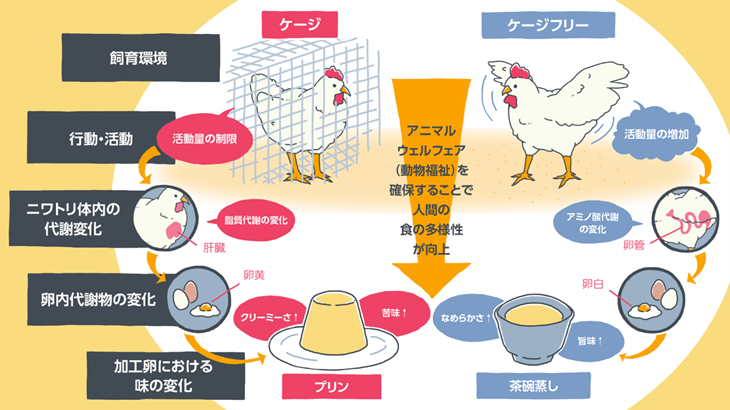
Tokyo University of Agriculture and Technology A research group led by Professor Tsuyoshi Shimmura at Graduate School Division of Science of Biological Production, in collaboration with Kagoshima University, Kyoto University, Japan University of Veterinary and Life Sciences, and Azabu University, discovered that the taste of eggs changes depending on how chickens are raised. Until now, the question of whether the physical environment in which chickens are kept in cages or cages (cage-free) changes changes in their taste and nutritional value, has not been clarified. The collaborative research group revealed that by integrating sensory evaluation using human tongues(2) and multi-omics analysis of egg components(3), caged eggs experience increased lipid metabolites to enhance creaminess and contain more bitterness and off-flavor components, whereas cage-free eggs show increased amino acids related to umami and sweetness, and these characteristics are highlighted by processing such as chawanmushi (Figure 1). These results indicate that, independent of the feed consumed by chickens, the physical environment itself causes metabolic changes within laying hens, which in turn alter the egg's composition and ultimately result in unique taste characteristics. Furthermore, since these differences are further enhanced by cooking and processing, it suggests that caged and cage-free eggs each have their own suitable cooking methods.
The results of this research were published in npj Science of Food (dated August 27, 2026).
Research background
Animal welfare is gaining global attention as a core theme for sustainable protein production, and a rapid shift from cage farming to cage-free farming is occurring, mainly in Western countries. In cage-free farming, it is possible to satisfy the behavioral needs of chickens and improve their health by providing them with ample space and resources such as perches and nesting boxes. On the other hand, cage-free eggs (free-range eggs) have higher production costs and retail prices, so scientific verification of whether they offer added value such as taste and nutritional value to justify the price is required for them to be widely accepted by consumers. However, until now, approaches to improving egg composition have mainly involved adding specific nutrients to the feed, and even in previous studies that reported differences in egg composition due to rearing environments such as cage-free farming, the conditions of what the chickens ingested, such as grass and insects in the open pasture, were mixed in, leaving it unclear how purely physical differences in rearing environment relate to the taste of the eggs. Furthermore, no research has been reported that comprehensively connects human senses in food science with molecular mechanisms such as genes and metabolites in biology.
Research results
In this study, we investigated the effects of different rearing systems on chickens and eggs over a five-year period. We placed both caged and free-range (cage-free) chickens in the same controlled environment and fed them the same feed. The impact was evaluated using an integrated approach that combined sensory evaluation of taste using human tongues with multi-omics analysis comprehensively analyzing metabolites and gene expression. This approach analyzed a series of biological processes in which differences in rearing environments affect egg taste.
As a result, cage rearing led to increased lipid metabolism due to restricted activity levels, resulting in increased long-chain fatty acids in the blood and egg yolk. This added characteristics such as creaminess, which are perceived by the human tongue, to cage eggs, and these characteristics were further enhanced when processed into products such as pudding (Figure 1). It was also found that changes in bile acid metabolism occur in the liver of cage-raised chickens, increasing secondary bile acids that contribute to bitterness and off-flavors in cage eggs, thereby suppressing the preference for eggs.
On the other hand, in cage-free eggs, increased activity levels enhance amino acid metabolism, leading to an increase in amino acids that make up umami and sweetness in the egg whites. These amino acids become more prominent through processing such as making chawanmushi (steamed egg custard), thus imparting characteristics such as umami and smoothness to cage-free eggs (Figure 1).
This study demonstrated at the molecular level that physical factors such as the rearing environment alter activity levels and behavioral diversity, thereby bringing about dynamic changes in the metabolism of chickens, particularly in the liver, which is responsible for the synthesis of egg yolk components, and the oviduct, which is responsible for the synthesis of egg white components. Furthermore, it revealed that these metabolic changes in the chickens' bodies are transmitted to the eggs via the bloodstream, independently of the feed they consume, resulting in the unique taste characteristics of caged eggs and cage-free eggs. Since these component characteristics are enhanced by cooking and processing, it is suggested that there are cooking methods suited to the characteristics of each type of egg, caged and cage-free.
Future developments
This research demonstrates that ensuring animal welfare improves the diversity of human diets, and can be considered the first study to scientifically embody the "One Welfare" concept, which integrates the health of animals and humans. Professor Niimura's research group is further expanding this research, exploring changes in egg nutrients due to rearing environments, and promoting neuroscientific research on emotional interactions between animals and humans.
Acknowledgments
This research was conducted by a collaborative research group consisting of Professor Tsuyoshi Shimmura of the Tokyo University of Agriculture and Technology Graduate School Division of Science of Biological Production (Advanced Research Center for One Welfare Animal Symbiosis Informatics Research Division), Nonoko Shimura, Eiki Asagi, Tadahiro Matsubara, Yuito Kamiyama from the same graduate Graduate School of Agriculture school, Shogo Matsunaga (now NARO), Associate Professor Daichi Ijiri from Kagoshima University, Shozo Tomonaga Assistant Professor Kyoto University, Jun-ichi Shiraishi Associate Professor from Nippon Veterinary and Life Science University, and Associate Professor Chihiro Kase from Azabu University. This research was supported by projects commissioned by the Ministry of Agriculture, Forestry and Fisheries (JPJ011279, JPJ013131), the JSPS Regional Core and Distinctive Research University Enhancement Promotion Project (J-PEAKS) (JPJS00420230003), research grants from the Hateikaikai Foundation, and encouragement research grants from the Lotte Foundation.
Glossary
Note 1) Animal welfare
This refers to the state of an animal, quantified as the sum of unpleasantness (stress) and pleasure (joy). For more details, see "Animal Welfare from the Perspective of Chicken Eggs" (Kagaku Dojin), "Animal Welfare Studies" (Showa-do), etc.
Note 2) Sensory evaluation
This method uses the five human senses to measure and evaluate the characteristics of food and substances. In this study, the taste and texture characteristics of cooked egg dishes such as pudding and chawanmushi were analyzed, primarily based on preference evaluations by a consumer panel of over 100 people.
Note 3) Multi-omics analysis
Metabolome analysis is an analytical method that comprehensively measures and integrates various molecular information within a living organism. In this study, we performed metabolome analysis, which comprehensively measures metabolites contained in egg yolk, egg white, and plasma, and transcriptome analysis, which comprehensively measures the expression levels of approximately 20,000 genes that function in chicken liver using next-generation sequencers.
Paper information
Title: Housing environments link egg taste through metabolic alterations in laying hens
Authors: Nonoko Shimura†, Eiki Asagi†, Shogo Matsunaga†, Shozo Tomonaga, Yuito Kamiyama, Tadahiro Matsubara, Jun-ichi Shiraishi, Chihiro Kase, Daichi Ijiri, Tsuyoshi Shimmura* (†Co-first author, *Corresponding author)
Publication: NPJ Science of Food
Publication date: August 27, 2026
DOI: 10.1038/s41538-026-01108-8
URL: https://www.nature.com/articles/s41538-026-01108-8
◆ Research Inquiries ◆
Tokyo University of Agriculture and Technology Graduate School Institute of Agriculture Division of Science of Biological Production
Professor Tsuyoshi Shinmura
TEL:042-367-5856
E-mail: shimmura (please include @ here)go.tuat.ac.jp
Related links (opens in a new window)
- Tokyo University of Agriculture and Technology Professor Tsuyoshi Shimmura Researcher Profile
- Tokyo University of Agriculture and Technology Professor Tsuyoshi Shimmura laboratory website
- Tokyo University of Agriculture and Technology Faculty of Agriculture Department of Biological Production, where Professor Tsuyoshi Shimmura belongs,