
Development of a New Experimental Apparatus to Investigate the Reaction Between Levitated Particles and Metal Vapors - Applying Atomic Physics Techniques to Atmospheric Chemistry -


Development of a New Experimental Apparatus to Investigate the Reaction Between Levitated Particles and Metal Vapors
- Applying Atomic Physics Techniques to Atmospheric Chemistry -
A research group consisting of Akira Kamada and Jiyatai, both doctoral students at Graduate School of Engineering, Tokyo University of Agriculture and Technology (TUAT), and Professor Atsushi Hatakeyama of Division of Applied Physics and Chemical Engineering, TUAT, has developed a new experimental apparatus capable of exposing microparticles to highly reactive alkali metal vapor while levitating and trapping them in a vacuum. In the demonstration experiment using this apparatus, after exposing levitated and trapped paraffin particles to alkali metal vapor and then irradiating them with ultraviolet light, changes in the charge-to-mass ratio of the paraffin particles were observed. The apparatus developed in this research is expected to be applied to the elucidation of interactions between alkali metal vapor and paraffin surfaces, which are important in quantum technologies such as atomic clocks and atomic magnetometers, as well as for investigating interactions between alkali metal vapor and fine particles in environments such as planetary surfaces.
The results of this research were published in the Journal of Aerosol Science (dated July 10th).
Paper Title: Development of an electrodynamic balance to study single levitated particles exposed to alkali-metal vapor
URL: https://doi.org/10.1016/j.jaerosci.2026.106862
Share Link URL (50 day's free access): https://authors.elsevier.com/a/1nPvU4zzczOL1
background
Particulate matter suspended in the atmosphere, known as aerosols, plays a key role in many environmental problems. To gain a deeper understanding of aerosol behavior, atmospheric chemistry has so far conducted research using an experimental device called an electrodynamic balance (Note 1) to capture particulate matter in the air and investigate the reactions of single aerosol particles with various gases. However, no electrodynamic balance capable of exposing aerosol particles to highly reactive metal vapors, especially alkali metal vapors, has been reported to date. It is hoped that developing such an electrodynamic balance will lead to a better understanding of particulate matter in polar mesospheric clouds involving alkali metal vapors, cosmic dust on the surfaces of the Moon and Mercury, and the formation process of aerosols produced by biomass combustion, which humanity has not yet been able to fully explain.
Furthermore, this electrodynamic balance can be used to investigate vapor cell atomic clocks and atomic magnetometers. These atomic clocks and magnetometers measure time and magnetic fields with high precision by controlling and measuring the spin (Note 3) state of alkali metal atoms sealed in an alkali metal vapor cell (Note 2). The inner wall of the vapor cell is sometimes coated with paraffin (Note 4) to prevent changes in the spin state of alkali metal atoms due to collisions, which improves measurement accuracy. However, many aspects of the interaction between alkali metal atoms and the paraffin surface remain unclear. By using an electrodynamic balance to levitate and trap paraffin microparticles in a vacuum, it is possible to investigate changes in the paraffin surface due to alkali metal vapor while avoiding the influence of the substrate, which is a problem in normal bulk sample measurements.
Research Structure
This study was conducted by a research group consisting of Akira Kamada and Jiyatai, graduate students at Department of Applied Physics and Chemical Engineering, Graduate School of Engineering, Tokyo University of Agriculture and Technology (TUAT), and Professor Atsushi Hatakeyama from Division of Applied Physics and Chemical Engineering, Institute of Engineering, TUAT. This research was supported by JSPS Grants-in-Aid for Scientific Research JP23K26538 and JP24K21729.
Research results
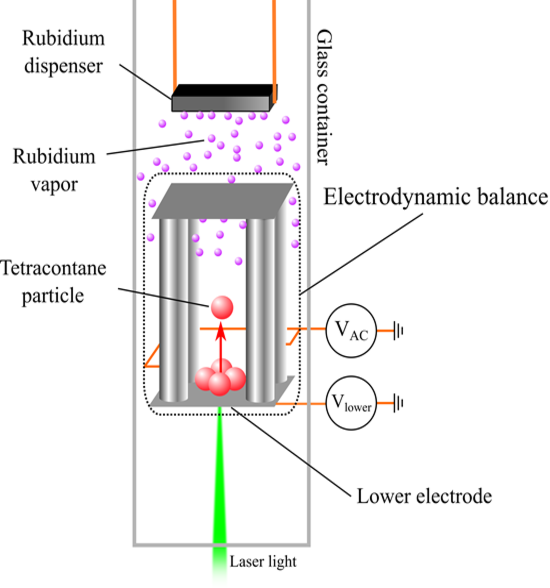
In this study, as shown in Figure 1, we developed apparatus that can expose levitated and trapped microparticles to alkali metal vapor using an electrodynamic balance, by applying expertise and techniques developed in the field of atomic, molecular, and optical physics. The electrodes of the electrodynamic balance were placed inside a glass container connected to a vacuum pump, and rubidium vapor was supplied into the cell by heating from a rubidium dispenser that can safely handle rubidium, a type of alkali metal. Furthermore, microparticles were placed on the lower electrode of the electrodynamic balance, and a pulsed laser was used to vibrate the lower electrode, launching and capturing the microparticles. The greatest feature of this apparatus is that, thanks to these unique innovations, experiments can be completed inside a vacuum glass container without exposing highly reactive alkali metal vapor to the atmosphere. In the demonstration experiment of this apparatus, tetracontane (C40H82) microparticles, a type of paraffin, were levitated and trapped in a vacuum, exposed to rubidium vapor, and then irradiated with ultraviolet light. As a result, a photo-induced effect was observed in which the charge-mass ratio of negatively charged tetracontane microparticles changed. The detailed mechanism of this phenomenon remains unclear, but it suggests some kind of change on the tetracontane surface caused by rubidium atoms.
Future developments
By elucidating the phenomena observed with the apparatus developed in this study, we expect to gain a detailed understanding of the interaction between alkali metal atoms and paraffin surfaces, which is related to the measurement accuracy of vapor cell atomic clocks and atomic magnetometers. Furthermore, the apparatus developed in this study is expected to be useful in research investigating the interaction between alkali metal vapors and various aerosol particles.
Glossary
Note 1) Electrodynamic balance
This device captures charged particles in a suspended state using the balance between Coulomb force and gravity. The original version of this device was used to determine the elementary charge in Millikan's oil drop experiment.
Note 2) Alkali metal vapor cell
A container in which vapors of alkali metals such as sodium and cesium float inside.
Note 3) Spin
The magnetic-like properties possessed by particles such as electrons and atoms. Classically, this is interpreted as a kind of rotational motion of the particles.
Note 4) Paraffin
A general term for saturated hydrocarbons represented by molecular formula CnH2n+2. The main component of candle wax.
◆ Research Inquiries ◆
Atsushi Hatakeyama
Professor, Division of Applied Physics and Chemical Engineering, Institute of Engineering
Tokyo University of Agriculture and Technology
TEL/FAX:042-388-7554
E-mail: hatakeya (please include @ here)cc.tuat.ac.jp
Related links (opens in a new window)
- Tokyo University of Agriculture and Technology and Technology Professor Atsushi Hatakeyama Researcher Profile
- Tokyo University of Agriculture and Technology Professor Atsushi Hatakeyama's Laboratory Website
- Tokyo University of Agriculture and Technology Faculty of Engineering Department of Applied Physics and Chemical Engineering to which Professor Atsushi Hatakeyama belongs.