
New technology developed to enable "hybrid power supply" using light and heat – Expected to be applied to next-generation IoT power supplies through thermoelectric conversion.


New technology developed to enable "hybrid power supply" using light and heat
– Expected to be applied to next-generation IoT power supplies through thermoelectric conversion.
Professor Wakana Kubo of the Tokyo University of Agriculture and Technology Institute of Engineering, Hidezumi Tamehiro (at the time) of the Graduate School of Engineering Department of Electrical Engineering and Computer Science master's student, and Akana Ueno, a master's student in the same department, demonstrated a new optical wireless power transfer technology using a thermoelectric device equipped with an interferometric thin film absorber that converts laser light into heat.
The developed wireless power supply system is expected to be developed as a next-generation power supply system that can operate a variety of devices from data communication devices to IoT devices without maintenance by combining it with metamaterial thermoelectric conversion technology that enables energy generation in a uniform thermal radiation environment.
The results of this research were published in the IEEE Journal on Wireless Power Technologies (April 8th).
Paper Title: Optical Wireless Power Transmission using Thermoelectric Device with Thin-Film Absorber
URL: https://ieeexplore.ieee.org/document/11477105/
Current situation
Optical Wireless Power Transmission (OWPT) is a technology that uses light energy such as laser light and LED light to supply power contactlessly, and is attracting attention as a promising technology for driving IoT devices and other devices from a distance. Currently, solar cells (photoelectric conversion) are mainly used in the light-receiving part, but since only the surface of the solar cell where the light is irradiated contributes to power generation, it was necessary to precisely control the light shining on the entire receiving surface. In other words, the question of how to efficiently and flexibly recover energy under limited irradiation conditions is a major barrier in the construction of next-generation wireless power delivery platforms.
Research Structure
This research was conducted by a joint research team led by Professor Wakana Kubo of the Tokyo University of Agriculture and Technology Institute of Engineering Division of Electrical Engineering and Computer Science, Hidezumi Tamehiro (at the time) of the Graduate School of Engineering Department of Electrical Engineering and Computer Science master's student, and Akana Ueno. This research was supported by the Grants-in-Aid for Scientific Research (A) (JP24H02232) and the Hitachi Foundation (1574).
Research results
This study proposes a novel optical wireless power transfer method using a thermoelectric device equipped with a thin-film absorber and experimentally verifies its characteristics (Figure 1). This method has a different operating principle from conventional photoelectric conversion, as it first converts incident light into heat using the thin-film absorber and then uses the resulting temperature difference to generate thermoelectric power. In a power transfer experiment using a 450 nm laser light (output 1 W), an output power of 2.0 mW and a conversion efficiency of 0.2% were achieved (Figure 2). This output power is sufficient to drive IoT devices. More importantly, even when irradiating a minute area where light is only directed onto a part of the device, the phenomenon of localized heat diffusing throughout the entire absorber substrate was confirmed. This revealed that multiple thermoelectric elements, including areas not directly exposed to light, contribute to power generation simultaneously. Power generation using such thermal diffusion is a characteristic that cannot be achieved with solar cells and enables efficient power acquisition without requiring precise light irradiation of the entire light-receiving surface. This study demonstrates the feasibility of OWPT using thermoelectric devices and its unique advantages.
Future developments
This technology, when integrated with metamaterial thermoelectric conversion [1–5] that generates electricity in a uniform thermal radiation environment, has the potential to be developed into a groundbreaking hybrid power supply system. In recent years, with the increasing sophistication of sensors, there is a demand for low-power operation to continuously monitor temperature, vibration, etc., while at the same time, high power is temporarily required during data communication. Thus, the challenge is how to reconcile these conflicting power requirements: low power during normal operation and high output during communication. The proposed system is expected to be a new power supply technology that solves this problem. In this system, metamaterial thermoelectric conversion constantly supplies the low power necessary for the autonomous operation of IoT sensors, and when a large amount of power is required, such as during remote data transmission, the OWPT of this research temporarily supplies additional energy (Figure 3). Thus, a dual device that integrates two independent thermoelectric mechanisms at the system level is expected to accelerate the spread of next-generation autonomous IoT devices as a highly versatile energy platform that covers low to high power.
References/Patents
[1] S. Saito, A. Yamamoto, Yu-Jung Lu, T. Tanaka, and W. Kubo*, “Artificial thermal flow control on mono-leg thermoelectric device”, Discover Nano, 20, 44 (2025).
[2] R. Nakayama, S. Saito, T. Tanaka, and W. Kubo*, “Metasurface absorber enhanced thermoelectric conversion”, Nanophotonics, 13, 1361-1368, 2024.
[3] Wakana Kubo, “Thermoelectric conversion by metamaterials”, Applied Physics 93 (9), 531, 2024.
[4] Wakana Kubo, “Metamaterial Thermoelectric Conversion and its Development”, Optronics, 514 (10), 98-102, 2024.
[5] Wakana Kubo, "Metamaterial Thermoelectric Conversion Enabling Thermoelectric Power Generation in a Uniform Thermal Radiation Environment," Electrical Computation, April 2026, pp. 20-25, 2026.4
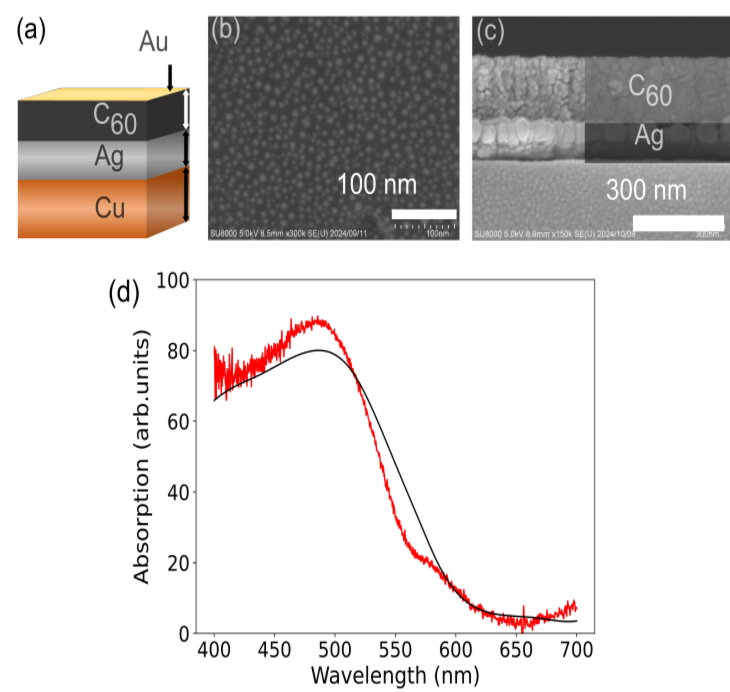
Figure 1 (a) Schematic diagram of the thin film absorber, (b, c) scanning electron microscope (SEM) images of the cross-section and planar view. The scale bars in (b) and (c) represent 300 nm and 100 nm, respectively. (d) Comparison of measured (red line) and calculated (black line) absorption spectra of the thin film absorber.
(Figure modified from IEEE Journal on Wireless Power Technologies (2026), DOI: 10.1109/JWPT.2026.3682232)

Figure 2 shows the generation characteristics of the thermoelectric device at the thin-film absorber electrode (red) and the control electrode (black) when irradiated with light of a wavelength of 450 nm.
(Figure modified from IEEE Journal on Wireless Power Technologies (2026), DOI: 10.1109/JWPT.2026.3682232)
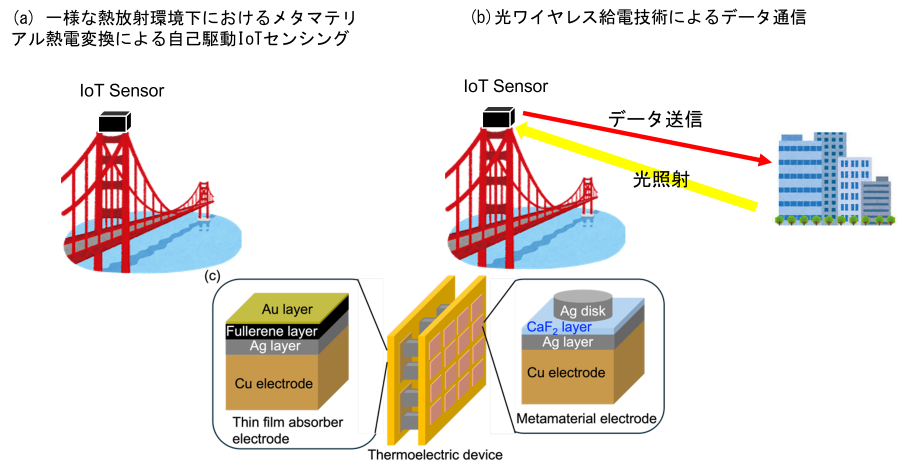
Figure 3 shows a conceptual diagram of a hybrid system combining metamaterial thermoelectric conversion and thermoelectric OWPT. This system enables 24-hour power generation and scalable IoT power supply.
(a) During environmental sensing, IoT sensors are driven by metamaterial thermoelectric conversion in a uniform thermal radiation environment. (b) During wireless data transmission, light is incident on a thermoelectric OWPT to drive a wireless communication device and transmit data wirelessly. (c) Schematic diagram of the integration method of a hybrid system combining metamaterial thermoelectric conversion and OWPT using a thin film absorber. A configuration in which the respective absorbers are placed on both sides of the thermoelectric element is assumed.
◆Inquiries about research◆
Tokyo University of Agriculture and Technology Institute of Engineering
Division of Electrical Engineering and Computer Science Professor
Wakana Kubo
Tel:042-388-7314
E-mail: w-kubo (put @ here)cc.tuat.ac.jp
◆Inquiries about the press◆
Tokyo University of Agriculture and Technology Public Relations Office
E-mail: koho2 (put @ here)cc.tuat.ac.jp
Related links (opens in a new window)
- Tokyo University of Agriculture and Technology Professor Wakana Kubo Researcher Profile
- Tokyo University of Agriculture and Technology Professor Wakana Kubo Laboratory Website
- Professor Wakana Kubo is a member of Department of Electrical Engineering and Computer Science Tokyo University of Agriculture and Technology Faculty of Engineering.