
Unraveling the mystery of the "bungee jumping" phenomenon of liquids caused by impact – the complex movement of viscoelastic jets could be described by a "simple model" –
Unraveling the mystery of the liquid "bungee jumping" phenomenon caused by impact.
— The complex motion of viscoelastic jets could be described with a "simple model" —
Tokyo University of Agriculture and Technology A research team led by Professor Yoshiyuki Tagawa of the Graduate School of Institute of Engineering Division of Mechanical Systems Engineering has analyzed the peculiar behavior of a viscoelastic liquid with rubber-like properties when it is ejected upon impact. Viscoelastic liquids are used in a wide range of industries, including inkjet printing, 3D printing, and bioprinting. In these techniques, the ejection of liquid as a "jet" is a thin, fast stream. However, when a viscoelastic liquid undergoes a rapid deformation, complex changes occur inside the jet. This unpredictable behavior posed a major challenge that prevented precise control of the printing process.
In this study, we succeeded in visualizing the velocity distribution and stress distribution that occur inside the jet during flight by using polarimetric measurement in addition to conventional high-speed camera measurements. As a result, we discovered a physical phenomenon that overturns conventional wisdom: the elongation rate (the speed at which a liquid expands) and stress (the force exerted inside the jet to maintain its shape) are kept extremely uniform in time and space inside the rapidly expanding jet. In addition, we clarified that this phenomenon can be described by the "Voigt type model", which is a basic mathematical model.
The results of this research were published in Applied Physics Letters, a leading journal in the field of physics published by the American Physical Society (AIP), and were selected as "Editor's Pick" as a particularly important paper.
The results of this research were published in the scientific journal "Applied Physics Letters" (March 23rd issue).
Paper title: Impact-induced viscoelastic bungee-jumper jets with uniform extension and stress
(Translation: Uniform extension and stress in viscoelastic bungee jumper jets driven by impact)
Authors: Kyota Kamamoto, Asuka Hosokawa, Yoshiyuki Tagawa
DOI: 10.1063/5.0320061
URL: https://pubs.aip.org/aip/apl/article/128/12/122701/3384409/Impact-induced-viscoelastic-bungee-jumper-jets
Current situation
Viscoelastic liquids used in inkjet printing, 3D printing, bioprinting, etc., exhibit both viscosity and elasticity in the face of rapid deformation. These are crucial factors in determining microscopic print quality, so it's crucial to elucidate how viscoelastic properties work in injected liquids. In particular, the "bungee jumper phenomenon", in which liquid is pulled back like rubber once stretched, is an extremely peculiar physical behavior, but due to its high-speed and complex movement, the mechanical details inside the jet during its expansion and contraction have been shrouded in mystery until now. By elucidating these principles, it will be possible to predict and control the behavior of liquid jets, which was previously difficult to control, with high accuracy, leading to improved quality of next-generation devices.
Research Structure
This research was conducted by Prof. Yoshiyuki Tagawa (Institute of Engineering Division of Mechanical Systems Engineering), Dr. Kyota Kamamoto (Graduate School of Engineering Doctoral Program), and Dr. Asuka Hosokawa (Graduate School of Engineering Master's Program) of the Tokyo University of Agriculture and Technology Graduate School. This research was supported by JSPS Grants-in-Aid for Scientific Research JP20H00223, JP 20H00222, JP220K20972, JP24H0028, JST JPMJPR21O5, and SBIR JPMJST2355.
Research results
This research group used an aqueous polyethylene oxide (PEO) solution as a model fluid and observed in detail the jet behavior generated by impact driving. By combining observations using a high-speed camera with analysis of birefringence (a phenomenon in which the properties of light change in proportion to stress) using polarization measurements, they succeeded in capturing the internal workings of a high-speed jet.
The analysis revealed that the impact-driven liquid jet exhibited an extremely spatiotemporal uniformity, even though conventional strong non-equilibrium flows were thought to be non-uniform. This was because it "extended with the same velocity gradient and generated the same stress intensity" at every point from tip to base. Normally, such fluid phenomena involving intense deformation would be expected to result in irregular stress distributions at different locations, but the viscoelastic jet revealed a physical characteristic where the entire system behaves uniformly and in a highly synchronized manner. Furthermore, by focusing on this uniform extension behavior, it was shown that experimental results could be predicted with extreme accuracy using only a simple "Voigt-type model" consisting of a spring and a dashpot connected in parallel, whereas previously this required sophisticated numerical calculations. This is a groundbreaking achievement that proves that very simple physical laws are hidden within complex fluid phenomena that appear uncontrollable at first glance. This result suggests that viscoelastic fluids may spontaneously form simple structures even in strong non-equilibrium conditions, leading to a new understanding of fluid dynamics.
Future developments
This research opens the way to controlling the "tearing" and "retraction" behaviors of viscoelastic liquids based on a simple mathematical model. This is expected to significantly contribute to process optimization in both industrial and medical fields, such as high-precision printing technology that suppresses ink splatter and microfabrication technology for high-viscosity liquids.
Furthermore, this method provides a valuable opportunity to observe the strong extensibility and highly non-equilibrium rheological response (changes in liquid properties caused under extreme conditions) of complex fluids, and establishes the foundation for a technology that enables observations under extreme conditions that are difficult to achieve or measure with conventional methods such as rotational rheometers.
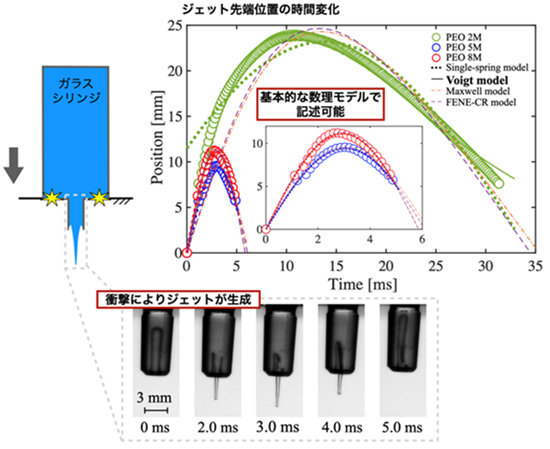
Figure 1 shows the behavior of liquid jets generated by impact: the liquid jet generation method (left panel), the time evolution of the jet captured by a high-speed camera (bottom panel), and the time evolution of the jet tip position analyzed from that data (right panel). The Voigt model accurately describes the jet behavior for all liquids. (Based on Kamamoto et al., Applied Physics Letters, 2026 (this study))
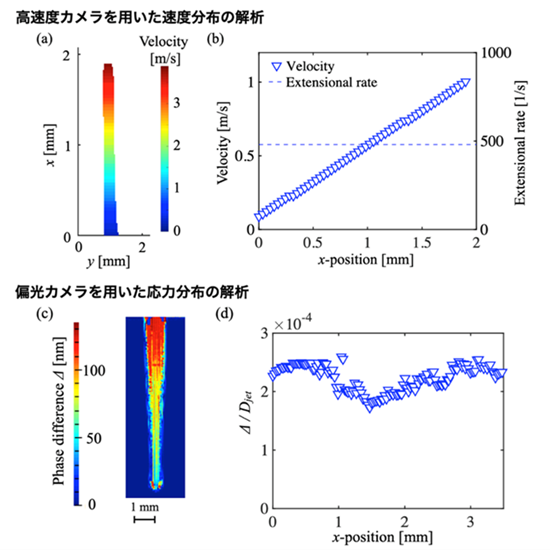
Figure 2 shows the internal analysis of a viscoelastic bungee jumper jet: the results of velocity distribution analysis using a high-speed camera (upper left panel), the change in velocity position (upper right panel), phase difference data captured by a polarizing camera (lower left panel), and the change in the position of an index indicating stress reconstructed from this analysis (right panel). (Based on Kamamoto et al., Applied Physics Letters, 2026)
Glossary
Note 1: Viscoelastic liquid
A liquid that possesses both the viscosity of a liquid and the elasticity of rubber, which is the property of returning to its original shape. When subjected to a strong external impact or sudden deformation, it instantly exhibits solid-like properties, such as spring-like behavior, and the liquid, once stretched, is rapidly pulled back, resulting in extremely complex behavior.
Note 2: Polarization measurement
This measurement technique utilizes the physical properties of light (polarization) to analyze the mechanical state inside a liquid. Viscoelastic liquids, such as polymer solutions, exhibit an optical property called birefringence, where the way light passes through changes as the internal molecules are stretched due to deformation. By using this property, it becomes possible to capture the stress distribution inside the liquid, which would otherwise be invisible.
Note 3 Growth rate
This is an indicator that shows how fast and to what extent an object is stretching. In typical liquid jets, the stretching speed varies from place to place, and eventually the jet breaks off (severs) at the narrowest point. However, the "Bungee Jumper Jet" in this study was found to be in an extremely stable state of "uniform stretching," where it stretches at the same rate from tip to base.
Note 4: Voigt model
This is one of the most fundamental mathematical models for explaining the behavior of viscoelastic materials. It is represented by a structure in which a "spring (elasticity)" that absorbs force and a "dashpot (viscosity)" that suppresses movement are connected in parallel. Normally, describing complex liquid jets ejected at high speeds requires a great many variables, but in this study, we proved that this simple model alone can accurately describe the phenomenon.
◆Inquiries about research◆
Tokyo University of Agriculture and Technology Graduate Institute of Engineering
Division of Mechanical Systems Engineering Professor
Yoshiyuki Tagawa
TEL/FAX:042-388-7407
E-mail: tagawayo (put @ here)cc.tuat.ac.jp
Related links (opens in a new window)
- Tokyo University of Agriculture and Technology and Technology Professor Yoshiyuki Tagawa Researcher Profile
- Tokyo University of Agriculture and Technology and Technology Professor Yoshiyuki Tagawa Laboratory Website
- Professor Yoshiyuki Tagawa is a member of Department of Mechanical Systems Engineering Tokyo University of Agriculture and Technology Faculty of Engineering.