
A protein that links reproductive arrest and body pigmentation in diapausing spider mites -Eggs or pigment, a seasonal switch that decides where lipids go-


August 28, 2026
Key points
- As winter approaches, female spider mites stop laying eggs and change from yellow-green to orange as they enter diapause (Note 1). How the two are linked had long remained unclear.
- The group identified TuPLAT10, a protein that becomes markedly more abundant in diapausing females. Suppressing its gene prevented both the arrest of egg laying and the color change.
- TuPLAT10 appears to switch the destination of lipids from eggs to pigment. Because it acts on both diapause and reproduction, it is a promising target for pest control.
Summary
A research group consisting of Rismayani, a doctoral student in the Graduate School of Bio-Applications and Systems Engineering (BASE) at Tokyo University of Agriculture and Technology (TUAT), Kanae Sai and Tomohiro Ohsako, who were master’s students at the time of the study (Ohsako is now a JSPS Research Fellow in the Graduate School of Science, The University of Osaka), and Professor Takeshi Suzuki of the Division of Sciences for Biological System, Institute of Agriculture, TUAT, working with Professor Rika Umemiya-Shirafuji of the National Research Center for Protozoan Diseases, Obihiro University of Agriculture and Veterinary Medicine, has identified one of the proteins that couple the arrest of egg laying with the change in body color during diapause in the two-spotted spider mite, Tetranychus urticae, a major agricultural pest worldwide.
Female spider mites use the length of the night to sense the season. After experiencing several long nights as immatures, they mature into adults that enter diapause, laying no eggs and turning from yellow-green to bright orange. This coupling of reproductive arrest and color change had been known since the early twentieth century, yet the mechanism behind it was unknown. The group has now shown that TuPLAT10, a protein carrying a single lipid-binding PLAT domain (Note 2), is one of the factors that connect the two events. With the onset of diapause, TuPLAT10 is thought to redirect lipids from eggs to pigment. The finding uncovers part of the seasonal adaptation strategy of spider mites and opens a route to pest control that works by manipulating reproduction and diapause.
The results were published in Insect Biochemistry and Molecular Biology on July 27, 2026.
Background
Spider mites (T. urticae) are tiny arthropods roughly 0.5 mm long. They are not insects but relatives of spiders and scorpions. Even so, they attack more than 1,100 plant species and develop resistance to acaricides so quickly that they are sometimes called superpests, which makes them one of the most serious agricultural pests worldwide.
In seasons that suit their growth and development, they do little but feed on plants and lay eggs, and their numbers rise explosively. In seasons that do not, they enter diapause, stop feeding, lay no eggs, and simply sit out the period. Females read night length as a calendar. When immatures experience long nights several times, diapause is induced once they reach adulthood. This ability to sense the season by measuring the length of the night is called photoperiodism (Note 3), and the spider mite has long served as a model organism in photoperiodism research.
A female in diapause lays no eggs, and her whole body turns from yellow-green to bright orange. The color comes from astaxanthin, one of the carotenoid (Note 4) pigments. Astaxanthin is also familiar as the natural red pigment of salmon and shrimp. Animals generally cannot make carotenoids and must obtain them from their food. Spider mites and a few insect species are exceptions. They acquired carotenoid biosynthetic enzymes from fungi through horizontal gene transfer (Note 5) and produce β-carotene themselves. Spider mites go one step further and convert that β-carotene into astaxanthin. Inside the body, most of the astaxanthin is stored bound to fatty acids. Because astaxanthin is a powerful antioxidant, it is thought to help the mites tolerate the environmental stresses of winter. The color change is therefore part of the preparation for overwintering.
How the arrest of egg laying and the color change were coordinated, however, remained a puzzle for a very long time.
Results
The group reared females under long nights, which induce diapause, and under short nights, which promote egg laying, then compared the proteins expressed at the adult stage by mass spectrometry (LC-MS/MS). Carotenoid biosynthetic enzymes and TuPLAT10 were both more abundant under the diapause-inducing condition.
A PLAT domain is a region that binds lipids. In most proteins that carry one, it works together with a catalytic domain that drives a chemical reaction. TuPLAT10 has a single PLAT domain and no catalytic domain. It therefore seems to bind lipids and govern where they are sent, rather than modifying them chemically.
The group next used RNA interference (Note 6) to suppress the TuPLAT10 gene. Females reared under long nights, the diapause-inducing condition, nonetheless laid eggs. Many of them also failed to turn orange. When a carotenoid biosynthetic enzyme gene was suppressed instead, some females likewise stayed yellow-green, but egg laying remained arrested. Only the suppression of TuPLAT10 prevented both responses together, which shows that TuPLAT10 is one of the factors linking them.
Astaxanthin, the source of the orange color, accumulates as esters with fatty acids. Lipids are equally indispensable for making eggs. The group proposes that lipids are directed to pigment when nights are long and to eggs when nights are short. The long-standing link between the color change and the arrest of egg laying is explained by this switch in lipid allocation, and TuPLAT10 may be the component that operates it (Figure 1).
Future work
Diapause is the basis on which spider mites survive winter and build up again the following spring. Blocking successful overwintering would prevent outbreaks from the next spring onward. Lipids are also essential for egg production, so cutting off their supply would suppress egg laying as well. Because TuPLAT10 acts on both diapause and reproduction, it is an attractive target for control.
The group will now trace the route by which information about night length reaches TuPLAT10. Phosphatidic acid (Note 7) is the candidate lipid that TuPLAT10 binds. Where that lipid is transported, how it is metabolized, and how it reaches astaxanthin and eggs are the questions to be addressed next.
Comment from the researcher
The dramatic color change that accompanies diapause in spider mites has fascinated many researchers. I am one of them. Seeing it for the first time as a student captivated me and drew me into research. Learning that this color change and the arrest of egg laying are connected through the allocation of lipids came as a surprise. New questions have arisen at the same time, and my curiosity about them keeps growing. (Professor Takeshi Suzuki)
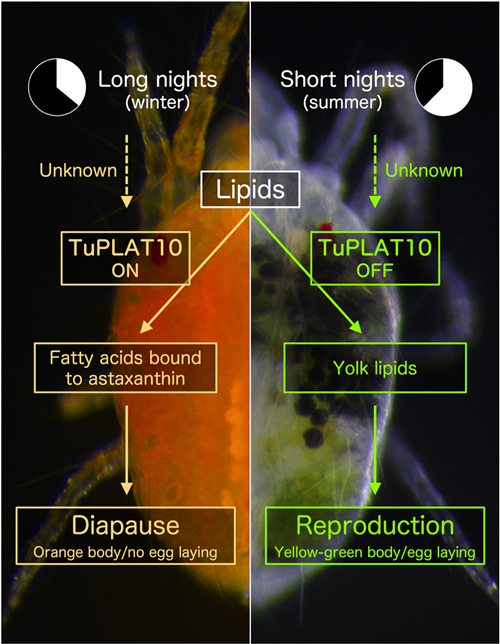
Figure 1. Schematic of how TuPLAT10 switches the destination of lipids according to the length of the night. The photograph shows a diapausing female (left half) placed beside a non-diapausing female (right half). Under the long nights of autumn and winter, TuPLAT10 increases and the lipids in the body are used as the fatty acids that bind astaxanthin. The body turns orange and egg laying stops. Under the short nights of spring and summer, TuPLAT10 decreases and lipids are directed to eggs. How the information on night length is conveyed to TuPLAT10 (dashed lines) is still unresolved.
Acknowledgments
This work was supported in part by the JICA SDGs Global Leader Program (202006547J063), JSPS KAKENHI (JP16K18661, JP18H02203, JP21H02193, JP24K21256), the Cabinet Office Moonshot Research and Development Program for Agriculture, Forestry and Fisheries (JPJ009237, managed by BRAIN), and Cooperative Research Grants of the National Research Center for Protozoan Diseases, Obihiro University of Agriculture and Veterinary Medicine (2024joint-9, 2025joint-1, 2026joint-5).
Glossary
Note 1. Diapause
A physiological state in which development or reproduction is arrested in advance, in anticipation of seasonal change. Unlike quiescence, which ends as soon as conditions improve, diapause is not lifted until a certain period has passed.
Note 2. PLAT domain
A structural unit of proteins that takes part in binding to lipids and to other proteins. The name comes from Polycystin-1, Lipoxygenase, and Alpha-toxin, three proteins that carry it.
Note 3. Photoperiodism
The property of sensing the season by measuring changes in the length of day and night, and of switching processes such as development and reproduction accordingly.
Note 4. Carotenoid
A general term for the yellow to red pigments produced by plants and microorganisms. In animals they contribute to body color, vision, and antioxidant defense. β-carotene and astaxanthin, which give spider mites their color, belong to this group.
Note 5. Horizontal gene transfer
The uptake of genes from an organism of another species, rather than inheritance from parent to offspring.
Note 6. RNA interference (RNAi)
A method that suppresses the activity of a target gene by supplying double-stranded RNA corresponding to it.
Note 7. Phosphatidic acid
One of the lipids that make up cell membranes. It sits at a branch point from which other lipids are formed, and it also takes part in signaling inside the cell.
Publication
Rismayani, Kanae Sai, Tomohiro Ohsako, Kohyoh Murata, Yuka Arai, Naoki Takeda, Masanobu Yamamoto, Rika Umemiya-Shirafuji, Takeshi Suzuki. A single PLAT domain protein couples reproductive arrest and carotenoid pigmentation during diapause in the two-spotted spider mite, Tetranychus urticae Koch. Insect Biochemistry and Molecular Biology, Volume 194, 104644. Published online on July 27, 2026.
DOI 10.1016/j.ibmb.2026.104644
URL https://doi.org/10.1016/j.ibmb.2026.104644
Contact
Inquiries about the research
Professor Takeshi Suzuki
Division of Sciences for Biological System, Institute of Agriculture
Tokyo University of Agriculture and Technology
Tel +81-42-388-7278
E-mail tszk(put @ here)cc.tuat.ac.jp
Inquiries from the media
PR Office, General Affairs Division, Tokyo University of Agriculture and Technology
E-mail koho2(put @ here)cc.tuat.ac.jp
Fund and Public Relations Section, Planning and General Affairs Division, Obihiro University of Agriculture and Veterinary Medicine
E-mail kouhou(put @ here)obihiro.ac.jp