
Traditional Japanese spousal terms shujin ("master") and kanai ("inside-the-house") may not be as gender-biased as their literal meanings suggest, according to a study of implicit associations.


June 4, 2026
Associate Professor Ri Nin and Professor Emeritus Kazuo Mori of Tokyo University of Agriculture and Technology found that the traditional Japanese spousal terms shujin ("master," husband) and kanai ("inside-the-house," wife), often criticized as reflecting patriarchal values, evoke implicit associations similar to those of the more neutral terms otto("husband") and tsuma ("wife"). The study employed the FUMIE Test, a paper-and-pencil measure of implicit associations developed by Mori and colleagues, and provides new insights into questions that conventional sociolinguistic methods have found difficult to address.
The results were published in the open-access journal PLOS ONE on June 3, 2026.
Paper Title: Are Japanese spousal terms as gender-biased as they seem? An examination using implicit association measures
URL:https://doi.org/10.1371/journal.pone.0330816
Background
Associate Professor Ri Nin has investigated spousal terms used in China, South Korea, and Japan, three countries that share important historical and cultural traditions. Her previous research suggested that Japanese spousal terms are more male-centered than their Chinese and Korean counterparts. Despite Japan's rapid modernization and Westernization, terms such as shujin ("master") and kanai ("inside-the-house") continue to be widely used. Why have such apparently patriarchal expressions persisted in contemporary Japanese society?
Research Structure
This study was conducted by Associate Professor Ri Nin of the Tokyo University of Agriculture and Technology Graduate School Institute of Engineering Division of Language and Culture Studies and Kazuo Mori Emeritus Professor specializing in applied cognitive psychology. This research was supported by the JSPS Grants-in-JP25K06689 of Scientific Research Fund.
Research Results
To explore this question, the researchers applied a psychological approach designed to examine implicit attitudes. Using the FUMIE Test, an adaptation of the Implicit Association Test, they compared the implicit associations elicited by the traditional terms shujin and kanai with those elicited by the more neutral terms otto and tsuma.
A total of 246 university students (162 men and 84 women) participated in the study. The results showed that the implicit association patterns for shujin and kanai were remarkably similar to those for otto and tsuma, despite the fact that the former pair is often regarded as linguistically patriarchal.
At the same time, male students showed stronger positive associations with male-related terms than female students, regardless of whether the traditional terms (shujin and kanai) or the neutral terms (otto and tsuma) were used.
These findings suggest two conclusions:
- The traditional terms shujin and kanai may have lost much of their original literal meanings and now evoke implicit associations similar to those of otto and tsuma.
- Male students tended to hold stronger male-centered implicit associations than female students, regardless of which set of spousal terms was used.
The findings also suggest that simply replacing potentially discriminatory terms with more neutral alternatives does not necessarily eliminate underlying implicit biases.
Future Directions
The present study focused on university students around the age of 20. Because implicit associations may differ across generations, the researchers have begun similar investigations with older Japanese participants. They also plan to develop Chinese and Korean versions of the FUMIE Test and to examine implicit associations related to spousal terms in those languages.
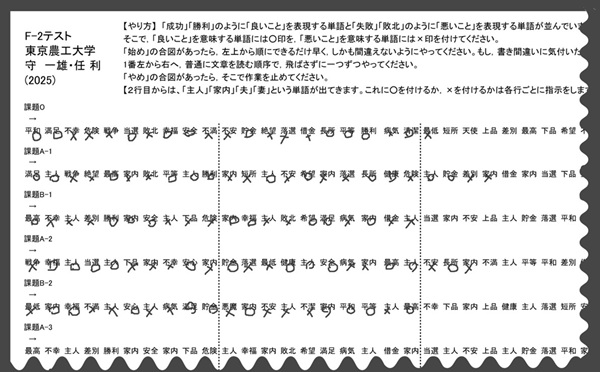
After practicing with the first line, which does not contain terms of address between husband and wife, from the second line onward, alternate between lines where you mark "husband" with a circle and "wife" with an "x," and lines where you mark "husband" with an "x" and "wife" with a circle.
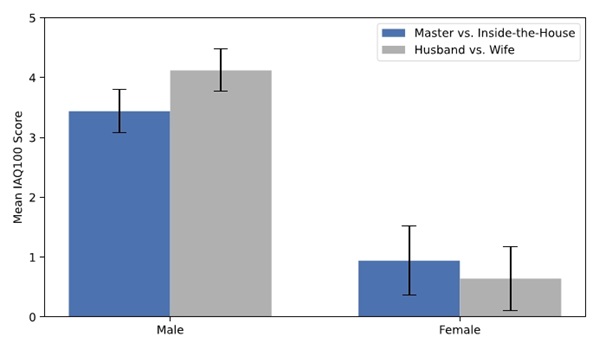
A higher value indicates that "master" or "husband" has a better underlying image.(Figure modified from PLoS ONE (2026), DOI: 10.1371/journal.pone.0330816)
Glossary
Note 1) Implicit Association Test
Developed by American social psychologist Greenwald and others, this psychological test explores implicit associative structures. Participants are asked to classify various words and pictures presented on a computer screen as "good" or "bad" as quickly as possible, and their reaction time is measured to determine the extent to which the classification is done "automatically (unconsciously)." The test is based on the principle that words and pictures that are normally considered good are classified as "good" more quickly than those classified as "bad." It is widely used in psychological research as a method that overcomes the problem of respondents not giving their "true feelings" in surveys, such as those studying racial discrimination and gender discrimination.
Note 2) FUMIE (Filtering Unconscious Matching of Implicit Emotions) test
This psychological test has been improved to allow for the simple exploration of latent associative structures using only paper and pencil, without the need for a computer. As shown in Figure 1, it measures how many words from a word list printed on A3 paper can be classified in one minute. In this study, two tasks were used: one where respondents classified "husband/wife" as "good/bad," and the other where they classified "husband/wife" as "bad/good." Respondents who habitually think in the former way performed better on the former task. Therefore, by examining the difference between the two tasks, it is possible to explore the respondent's latent associative structure. The FUMIE test utilizes the principles of latent association tests while having the advantage of being able to be administered simultaneously to a group, similar to a questionnaire.
Note 3) IAQ100
The FUMIE test indexed how many more instances per 100 words a student could classify "husband" and "wife" as "good" or "bad" compared to the reverse task. It was found that male students could classify "husband" and "wife" as "good" about 4 more times per 100 words, while there was almost no difference among female students.
◆ Inquiries about research ◆
Division of Language and Culture Studies
Institute of Engineering
Tokyo University of Agriculture and Technology,
Ri Nin, Associate Professor
E-mail: ninri (please put @ here) cc.tuat.ac.jp
Related Information
Researcher information:
Associate Professor Ri Nin
Japanese (夫婦呼称語「主人・家内」は字義から想定されるほど男女差別的ではないことを潜在イメージの計測によって検証)