
How a pest mite overcomes the catechin defenses of tea plants -Two changes in a detoxifying enzyme of fungal origin, in its structure and in its expression, hold the key-


November 18, 2026
Key points
- Catechins(Note 1), which are abundant in green tea, are known as antioxidants that benefit human health. For herbivorous pests, however, they are a threefold defense. They are toxic, they irritate the pest on contact, and they inhibit feeding.
- Neither the two-spotted spider mite (TSSM), an extreme generalist that feeds on more than 1,100 plant species, nor the Kanzawa spider mite (KSM) from host plants other than tea can reproduce on tea plants. KSM from a tea farm, by contrast, were barely affected by any of the three defenses. They were especially tolerant of the catechol-type catechins, surviving even a 10% solution.
- The research group identified an enzyme, DOG15, whose expression increases in KSM from a tea farm only when they feed on tea. The gene for this enzyme was originally acquired from fungi by horizontal gene transfer(Note 2). KSM-type DOG15 differs from TSSM-type DOG15 at just two amino acid positions, and it breaks down catechins more efficiently.
- Adaptation to tea therefore involves two stages of change in DOG15. The first is a difference in the structure of the enzyme between the two species. The second is the increase in its expression, which is seen only in the tea-farm population of KSM.
Summary
A research group from Tokyo University of Agriculture and Technology (TUAT), Kyushu University, the University of Western Ontario (Canada) and Michigan State University (USA) has revealed part of the mechanism by which the Kanzawa spider mite (KSM) Tetranychus kanzawai (Figure 1), a major pest of the tea plant Camellia sinensis, detoxifies catechins.
The group was led by Professor Takeshi Suzuki (Division of Sciences for Biological System, Institute of Agriculture, TUAT) and included Naoki Takeda (then a doctoral student at the Graduate School of Bio-Applications and Systems Engineering (BASE), TUAT, and a JSPS Research Fellow DC1), Ryutaro Murakami (then a master's student at BASE, TUAT) and Masanobu Yamamoto (Postdoctoral Researcher, Graduate School of Advanced Interdisciplinary Science, TUAT). The international collaborators were Assistant Professor Shogo Sasaki (Faculty of Science, Kyushu University; formerly Specially Appointed Assistant Professor at the Institute for Fostering Leadership to create future value through Outstanding Research, Innovation and Sustainable Higher education (FLOuRISH), TUAT), Professor Vojislava Grbić (University of Western Ontario; formerly Foreign Researcher at the TUAT Institute of Global Innovation Research) and Professor Maksymilian Chruszcz (Michigan State University).
Catechins are chemical defense compounds that protect tea plants from herbivorous pests and pathogens. Even the two-spotted spider mite (TSSM) T. urticae, an extreme generalist known as a “super pest,” cannot use tea as a host plant. The closely related KSM, however, includes populations that reproduce in tea farms. The research group asked how these tea-farm populations overcome the catechin defenses, and what makes them different from mites that cannot. The answer lay in DOG15, one of a family of enzymes called intradiol ring-cleavage dioxygenases (DOGs)(Note 3) that spider mites acquired from fungi by horizontal gene transfer. KSM-type DOG15 breaks down catechins more efficiently than the TSSM type, and in a tea-farm population its expression increased when the mites fed on tea. The group concluded that two changes in this catechin-detoxifying enzyme, one in its structure and one in the regulation of its expression, account for part of how the mite counters the catechin defenses of tea.
The findings were published in eLife as a Reviewed Preprint on February 18, 2026, as a revised Reviewed Preprint (version 2) on September 11, 2026, and as the Version of Record on November 17, 2026.
Background
Catechins protect tea plants from herbivorous pests and pathogens, yet some herbivores still reproduce on tea. Why only certain species or populations can tolerate catechins has remained poorly understood.
Spider mites are tiny arthropods about 0.5 mm in body length even at the adult stage. They are not insects but belong to the class Arachnida, together with spiders and scorpions. Despite its extremely wide host range, TSSM has never been reported to infest tea. The closely related KSM, in contrast, is one of the major pests of tea. Moreover, KSM comprises “tea-adapted populations” that can reproduce on tea and “tea-non-adapted populations” that cannot. By comparing these three populations of two species, the research group set out to uncover how adaptation to tea arises.
Results
1) Catechins defend tea plants against spider mites in three ways
The research group reared the tea-adapted and tea-non-adapted populations of KSM and TSSM on tea leaves for 10 days and recorded survival and egg laying. Only the tea-adapted population was able to reproduce. After 10 days, about 90% of the tea-adapted KSM were still alive, compared with about 5% of the tea-non-adapted KSM and about 33% of TSSM, and the latter two laid almost no eggs. The group then immersed mites in aqueous solutions of the four major green tea catechins and compared their toxicity. For the catechol-type catechins (epicatechin and epicatechin gallate), more than half of the tea-adapted KSM survived even a 10% solution (100,000 ppm), the highest concentration tested, so their median lethal concentration(Note 4) far exceeded that of TSSM.
Catechins affected not only survival but also behavior. On glass plates coated with catechins on one side only, mites of the tea-non-adapted KSM and TSSM avoided the coated side (contact irritancy). The group then coated leaves with catechins and covered them with a thin film, so that the mites could feed only by penetrating the film with their stylets(Note 5), without their legs touching the leaf surface. Under these conditions, the tea-non-adapted KSM hardly fed at all (feeding inhibition). The tea-adapted KSM, in contrast, was barely affected by any of the three defenses, toxicity, contact irritancy and feeding inhibition.
2) The key is DOG15, an enzyme of fungal origin
The three populations were reared on tea leaves and on kidney bean leaves, a favorable host for spider mites, and the types and amounts of mRNAs and proteins they expressed were compared by transcriptome(Note 6) and proteome(Note 7) analyses. Only one gene, DOG15, was more highly expressed, at both the mRNA and the protein level, specifically when the tea-adapted KSM fed on tea leaves. In tea-adapted KSM feeding on tea, the amount of DOG15 mRNA was about 20 times that in the same mites feeding on kidney bean and about 32 times that in TSSM feeding on tea. When the group suppressed DOG15 by RNA interference(Note 8), survival on tea fell significantly even in the tea-adapted KSM. High expression of DOG15 is therefore essential for life on tea.
3) The KSM type of the enzyme degrades catechins more efficiently
The DOG15 amino acid sequences of KSM and TSSM differ at only two positions, the 127th and 203rd amino acid residues. The 203rd residue is located right next to one of the amino acids that hold the iron atom at the catalytic center of the enzyme. The group produced both versions of the enzyme and compared their activity. The KSM type broke down catechins more efficiently than the TSSM type. When the amount of DOG15 present in mites feeding on tea was also taken into account, the difference in activity was largest for the catechol-type catechins. This matches the toxicity assays, in which the tea-adapted KSM was most tolerant of exactly these catechins.
4) Adaptation to tea depends on both the “structural change” and the “expression control” of DOG15
The DOG15 amino acid sequence was identical between the tea-adapted and tea-non-adapted KSM. In other words, the two amino acid differences from TSSM are shared by KSM as a species, but on their own they are not enough for survival on tea. On top of this structural difference, only the tea-farm population has acquired the ability to boost DOG15 expression sharply when feeding on tea. This is the first demonstration for a DOG that a gene received from fungi has been put to use against plant chemical defenses through two stages of change, a structural difference between species and a difference in expression control within a species (Figure 2).
Future prospects
Several questions remain open. What catechins are converted into by DOG15 has not yet been confirmed. Why the tea-adapted KSM is insensitive to the irritant and feeding-inhibiting effects of catechins is unexplained, as is the mechanism that switches on DOG15 expression during tea feeding. The research group will continue to address these questions.
From an applied perspective, DOG15 is one of the detoxifying enzymes essential for the reproduction of tea-adapted KSM on tea. Approaches such as RNA interference targeting the DOG15 gene are expected to lead to new methods for controlling KSM in tea farms.
Comment from the researcher
“I was born in Shizuoka, a major green tea-growing region of Japan, and until I graduated from high school, tea fields and Mt. Fuji were part of my everyday scenery. Back then, I had no idea that such a battle was being fought between tea plants and spider mites in those very fields. I am deeply moved to have been able to reveal part of the ingenious mechanism by which spider mites overcome catechin defenses through the structural change and expression control of an enzyme of fungal origin.” (Professor Takeshi Suzuki)
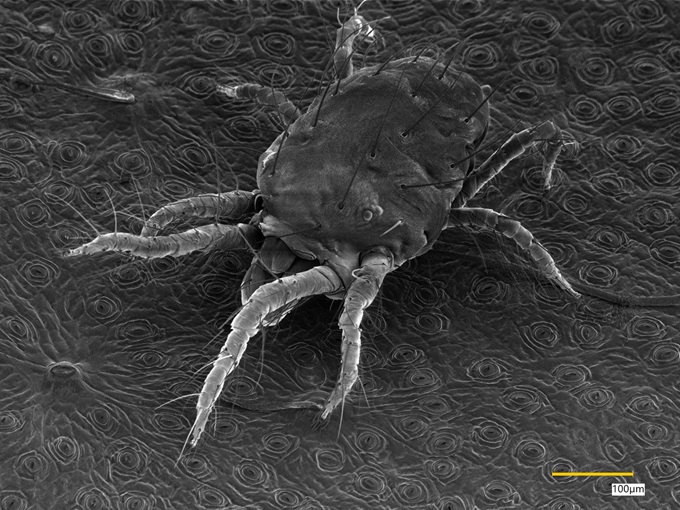
Figure 1. Scanning electron micrograph of an adult female Kanzawa spider mite (Tetranychus kanzawai) infesting a tea leaf. The mite is about 0.5 mm in body length and feeds by inserting its stylets into the leaf and sucking out the cell contents. The oval structures scattered across the leaf surface are stomata. Scale bar, 100 µm.
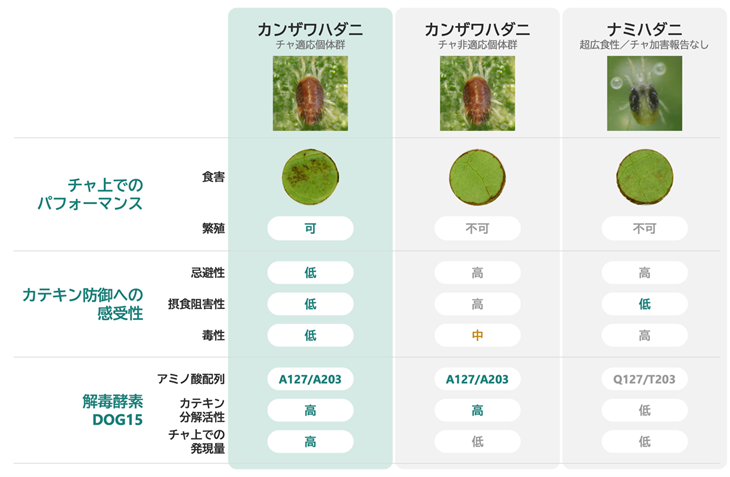
Figure 2. How the Kanzawa spider mite overcomes the catechin defenses of tea plants. The tea-adapted and tea-non-adapted populations of the Kanzawa spider mite and the two-spotted spider mite are compared in terms of performance on tea (feeding damage and reproduction), sensitivity to catechin defenses (contact irritancy, feeding inhibition and toxicity) and the detoxifying enzyme DOG15 (amino acids at positions 127 and 203, catechin-cleaving activity and expression level on tea).
Acknowledgments
This work was supported in part by JSPS KAKENHI (JP22J22156, JP16K18661, JP18H02203, JP21H02193 and JP24K21256), the Moonshot Research and Development Program for Agriculture, Forestry and Fisheries of the Cabinet Office, Japan (JPJ009237; funding agency BRAIN) and the US Department of Agriculture National Institute of Food and Agriculture (USDA-NIFA award 2020-67014-31179, NSF/NIFA Plant Biotic Interactions Program).
Glossary
Note 1) Catechins
A group of flavonoids abundant in green tea and responsible for its astringency. The four major catechins are epicatechin, epicatechin gallate, epigallocatechin and epigallocatechin gallate. According to the number of hydroxyl groups on one of the rings (the B ring), they are classified into catechol-type catechins (epicatechin and epicatechin gallate) and pyrogallol-type catechins (epigallocatechin and epigallocatechin gallate).
Note 2) Horizontal gene transfer
The acquisition of genes from an organism of a different species, rather than by inheritance from parent to offspring. The DOG genes of spider mites are thought to have been acquired from fungi in this way.
Note 3) Intradiol ring-cleavage dioxygenase (DOG)
An enzyme with iron at its active center that uses molecular oxygen to break open the aromatic ring of compounds such as catechols and pyrogallols, cleaving the bond between the two carbons that carry the hydroxyl groups (intradiol cleavage). In bacteria and fungi, DOGs break down aromatic compounds. The TSSM genome contains 17 DOG genes.
Note 4) Median lethal concentration (LC50)
The concentration of a substance at which half of the tested individuals die. The higher the value, the greater the tolerance to the substance.
Note 5) Stylets
The movable digits of the paired chelicerae, the first pair of appendages. Each is whip-like with a trough-shaped cross section, and the two movable digits join to form the stylets. During feeding, the stylets are inserted into leaf mesophyll cells and used to inject saliva and to suck up the pre-digested cell contents.
Note 6) Transcriptome analysis
A method for examining the types and amounts of mRNAs expressed in cells or organisms.
Note 7) Proteome analysis
A method for examining the types and amounts of proteins expressed in cells or organisms.
Note 8) RNA interference (RNAi)
A phenomenon in which double-stranded RNA introduced into cells triggers the suppression of genes with complementary sequences.
Publication
Title
Adaptation of an herbivorous arthropod to green tea plants by overcoming catechin defenses
Authors
Naoki Takeda, Brendan Abiskaroon, Ricardo Hernandez Arriaza, Ryutaro Murakami, Shogo Sasaki, Masanobu Yamamoto, Vladimir Zhurov, Vojislava Grbić, Maksymilian Chruszcz, Takeshi Suzuki
Journal eLife
Publication date November 17, 2026 (Version of Record)
DOI 10.7554/eLife.110082
URL https://doi.org/10.7554/eLife.110082
Contact
[Research inquiries]
Division of Bioscience, Institute of Agriculture, Tokyo University of Agriculture and Technology
Takeshi Suzuki, Professor
Tel +81-42-388-7278
E-mail tszk(put @ here)cc.tuat.ac.jp
[Media inquiries]
Public Relations Office, General Affairs Division, Tokyo University of Agriculture and Technology
E-mail koho2(put @ here)cc.tuat.ac.jp
Public Relations Office, Kyushu University
E-mail koho(put @ here)jimu.kyushu-u.ac.jp