
World’s First Stable Transformation System Established for Late Watergrass, a Major Rice-Field Weed —Making it possible to test gene function directly in the weed itself—


October 19, 2026
Key points
- We established the world’s first stable genetic transformation system for late watergrass (Echinochloa phyllopogon).
- Genes can now be tested directly in the weed itself, rather than only in model plants.
- This opens the way to a much clearer understanding of how weeds adapt to their environment and survive weed-control measures.
Overview
A research team led by Associate Professor Satoshi Iwakami of Tokyo University of Agriculture and Technology, together with Assistant Professor Takahiro Gondo, Manami Sugahara (at the time of the study), Specially Appointed Assistant Professor Hwan May Ng of the University of Miyazaki, and Associate Professor Kentaro Yasuda of Akita Prefectural University, has established the world’s first transformation system that allows genes to be introduced into late watergrass and the transformed cells to be regenerated into whole plants.
Until now, gene studies in major agricultural weeds have largely had to rely on model plants, because introducing genes directly into the weeds themselves was technically very difficult. This made it hard to know whether a gene discovered in a weed really works in the same way inside that weed. The new method makes it possible to test gene function directly in late watergrass. In the future, this technology could help researchers understand herbicide resistance and other weed adaptations, and may contribute to the development of new herbicides and more sustainable weed-management strategies.
The study will be published in Plant Cell Reports on 14 October 2026.
Background
Advances in DNA sequencing have made it possible to identify many genes and DNA changes that may be responsible for herbicide resistance in weeds. But finding a candidate gene is only the first step. To show that it really causes resistance, researchers need to introduce that gene—or a particular gene variant—into the weed and see whether the plant actually becomes resistant.
This kind of direct test is important not only for herbicide resistance but also for many other weed traits. However, tissue culture and plant regeneration from cultured cells are often difficult in major agricultural weeds, including late watergrass. As a result, the development of genetic transformation methods for introducing genes directly into these weeds has lagged behind, making it difficult to directly investigate the functions of genes in weeds themselves.
What the researchers achieved
The researchers first compared several types of callus—masses of plant cells produced from seeds—to find which ones were best suited for gene introduction and plant regeneration (Figure 1). They then used a “particle bombardment” method, in which tiny metal particles coated with DNA are shot into plant cells, and developed a complete procedure for regenerating those cells into healthy plants.
To confirm that the introduced genes were really present and working, the team introduced a reporter gene called GUS, which produces a blue color when active, together with the bar gene, which allows transformed cells to be selected with a herbicide. The regenerated plants showed that the introduced genes had been stably incorporated and were functioning normally (Figure 2).
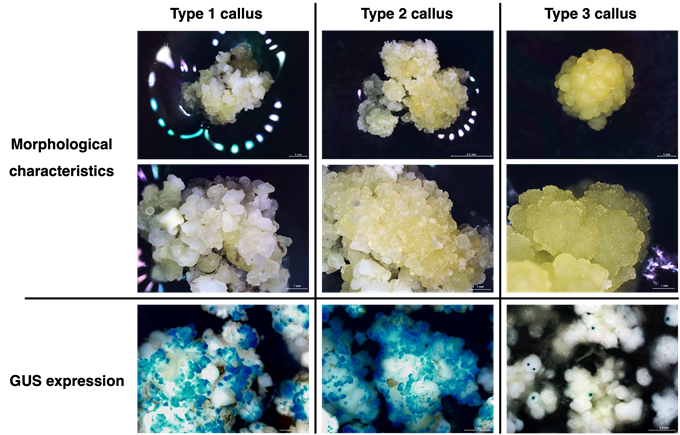
Figure 1. Callus types suitable for transformation in late watergrass. Type 1 and Type 2 calli are suitable for gene introduction and plant regeneration, whereas Type 3 callus shows low transformation efficiency. Blue staining indicates that the introduced gene is functioning. (Adapted from Gondo et al. 2026)
Future directions
Late watergrass is one of the most serious weeds in rice production and is known for its ability to rapidly evolve traits such as herbicide resistance. Until now, researchers have had to rely mainly on model plants when testing the genes behind these traits.
With this new system, researchers can introduce specific genes into late watergrass—or disrupt them—and directly test what they do in the weed itself. This should make it possible to study, at the DNA level, how late watergrass adapts to herbicides and other control measures. The knowledge gained could ultimately support new ways to slow the spread of herbicide-resistant weeds and help guide the development of next-generation herbicides.
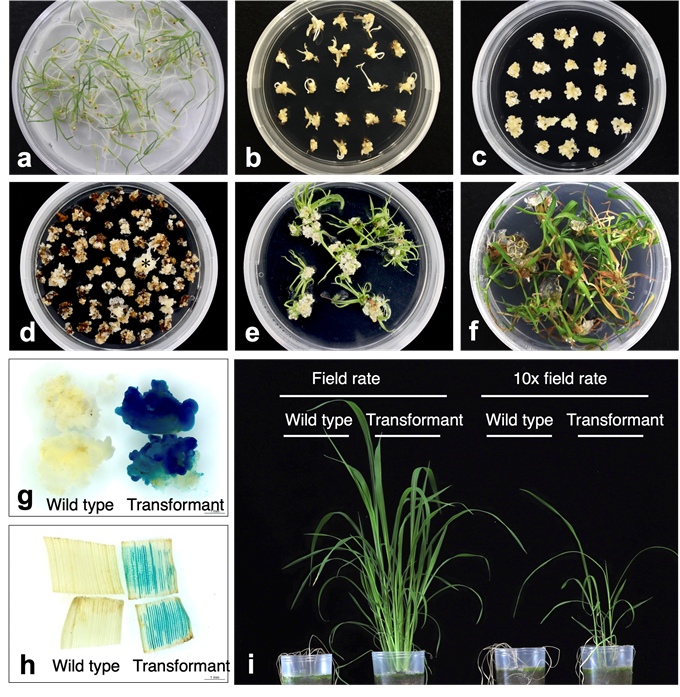
Figure 2. Transformation procedure established in this study. Callus was induced from seeds (a–c), DNA was introduced, transformed callus was selected (d), and whole plants were regenerated (e, f). Gene activity was confirmed by blue staining (g, h) and by herbicide response (i). (Adapted from Gondo et al. 2026)
Funding
This work was supported by JSPS KAKENHI (JP19H02955, JP22H02347, JP23K23612) and the Japan Science and Technology Agency (JST) PRESTO program (JPMJPR24N2).
Glossary
Genetic transformation: A research technique in which a gene is introduced into an organism so that researchers can study what the gene does.
Herbicide-resistant weed: A weed that has evolved the ability to survive an amount of herbicide that would normally kill it. This can make previously effective weed-control methods less useful.
Tissue culture: A technique for growing plant cells or tissues under sterile conditions. It is a basic method used for gene introduction and for regenerating whole plants.
Callus: A mass of undifferentiated plant cells produced in culture. Under suitable conditions, callus can form shoots and roots and regenerate into a whole plant.
Paper information
Title: Development of a genetic transformation system in Echinochloa phyllopogon by particle bombardment
Authors: Takahiro Gondo*, Manami Sugahara, Hwan May Ng, Kentaro Yasuda, Satoshi Iwakami*
Journal: Plant Cell Reports
Publication date: 14 October 2026
DOI: 10.1007/s00299-026-03978-4
URL: https://link.springer.com/article/10.1007/s00299-026-03978-4
Contacts
Research contact
Associate Professor Satoshi Iwakami
Division of Bioregulation and Biointeraction, Institute of Agriculture, Tokyo University of Agriculture and Technology
Tel: 042-367-5763
E-mail: iwakamis(put @ here)cc.tuat.ac.jp
Media contacts
Tokyo University of Agriculture and Technology, Public Relations Office: koho2(put @ here)cc.tuat.ac.jp
University of Miyazaki, General Affairs and Public Relations Division: kouhou(put @ here)miyazaki-u.ac.jp
Akita Prefectural University, Public Relations: koho_akita(put @ here)akita-pu.ac.jp
Japan Science and Technology Agency (JST), Public Relations Division: 03-5214-8404 / jstkoho(put @ here)jst.go.jp
JST program contact
Miho Okishiro
Department of Strategic Basic Research, Life Innovation Group, JST
Tel: 03-3512-3524
E-mail: presto(put @ here)jst.go.jp