
Precision in Structure, Power in Detection - Demonstration of a High-Performance Photodetector Using an Epitaxially-Connected Colloidal Quantum Dot Superlattice -


March 23, 2026
Dadan Suhendar (Doctoral student), Yuto Aoki (alumnae - Bachelor), Chisa Nishiyama (Bachelor student) from the Department of Chemical Physics and Engineering, Graduate School of Engineering, Tokyo University of Agriculture and Technology (TUAT); and Satria Zulkarnaen Bisri, Associate Professor from the Department of Advanced Electrical and Electronics at the Institute of Engineering, Tokyo University of Agriculture and Technology (TUAT); as well as Ricky Dwi Septianto, Postdoctoral Researcher at RIKEN and Indonesian National Research and Innovation Agency (BRIN), have demonstrated high performance photodetector devices based on epitaxially-connected quantum dot superlattices. This research establishes a clear foundation for understanding how light and electrons interact in epitaxially connected quantum dot superlattices — materials consisting of tiny semiconductor particles arranged in a regular pattern — and represents a significant step toward the design of next-generation high-performance photodetectors.
The results of this research have been published online on March 3rd in Advanced Optical Materials.
Title: High-Performance Photodetectors of Quasi-2-Dimensional Epitaxially-Connected Quantum Dot Superlattices
URL:https://advanced.onlinelibrary.wiley.com/doi/10.1002/adom.202503565
Background:
One of the greatest challenges in nanotechnology is finding a way to carefully assemble tiny semiconductor particles—known as quantum dots—each measuring just a few nanometers (1 nanometer is one-billionth of a meter) in size, one by one, to form an orderly structure while preserving their unique “quantum” properties. Scientists hope that by controlling the process by which these particles naturally assemble, they can construct large-scale, crystal-like networks of quantum dots. If this is achieved, it could lead to significant improvements in next-generation electronic and optical devices, such as solar panels and optical sensors.
Currently, materials made from colloidal quantum dots face a major challenge: poor electrical conductivity. It is because the particles are not perfectly aligned, resulting in non-uniform energy levels. These imperfections slow down charge transport and limit the performance of quantum dot devices. Recently, significant progress has been made in constructing highly organized sheet-like structures using tiny lead sulfide (PbS) quantum dots (published in “Nature Communications” in 2023*). In this new structure, the particles are more orderly aligned. Thanks to this improved arrangement, electricity now flows through the material approximately one million times more easily. In fact, the flow of charge exhibits behavior similar to that of a metal.
However, there has long been concern about the use of colloidal quantum dots. The value of quantum dots lies in their “quantum confinement” properties, which enable precise control over their internal electronic behavior. Some scientists worry that if electrons move too freely, as they do in metals, this unique quantum behavior may be weakened. At this point, it is not yet fully understood how this new highly ordered structure affects the actual performance of devices such as photodetectors. This study represents the first attempt to construct and test a photodetector using an ordered quantum dot structure with this unique junction configuration.
Research Framework: This research was led by Associate Professor Satria Zulkarnaen Bisri of the Division of Advanced Electrical and Electronic Engineering at the Institute of Engineering, Tokyo University of Agriculture and Technology. The experiments were conducted by Dadan Sühender, a doctoral student in the Department of Chemical and Physical Engineering at the Graduate School of Engineering; Yuto Aoki (at the time of the research) and Chisai Nishiyama from the Department of Chemical and Physical Engineering at the Faculty of Engineering; and Dr. Ricky Dwi Septianto, a visiting researcher at the university and a postdoctoral researcher at the Center for Emergent Matter Science, RIKEN, and the Indonesian National Research and Innovation Agency (BRIN). This research was partially supported by the Iketani Science and Technology Foundation, the Thermal and Electric Energy Technology Foundation, the Support Center for Advanced Telecommunications Technology Research (SCAT), and the 2024 RIKEN Incentive Research Grant.
Research results:
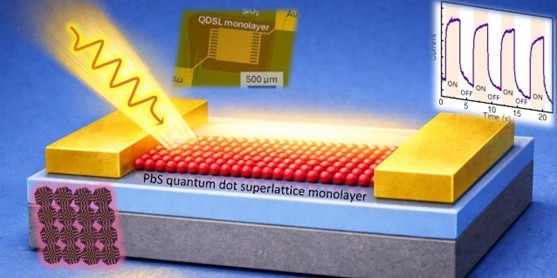
In this paper, we demonstrated a high-performance photodetector device that uses only a single-layer quasi-two-dimensional epitaxial junction PbS quantum dot superlattice (QDSL) as the active material. A quasi-two-dimensional epitaxial junction quantum dot is a material in which nanometer-sized semiconductor particles (quantum dots) are arranged in a nearly planar configuration, with specific faces of adjacent particles directly connected as a crystal lattice. This arrangement is expected to facilitate electron movement between particles while preserving the individual properties of each quantum dot. A long-standing challenge in quantum dot research has been balancing two critical properties: strong quantum confinement (which enhances light absorption) and efficient charge transport (which enables the easy flow of electrical signals). In conventional quantum dot thin films, the quantum dots are separated by insulating molecules, which maintain the confinement effect but slow charge transport. There is concern that strengthening the bonds between quantum dots to enhance conductivity will weaken quantum confinement.
These research results demonstrate that it is possible to achieve both of these properties simultaneously. In epitaxially connected superlattice structures, quantum dots are directly connected in a highly ordered array, allowing charges to move much more freely within the material. At the same time, the intrinsic quantum confinement effect, which is responsible for excellent light absorption, is almost completely preserved. Due to this improvement in charge transport, the photodetector developed in this study exhibits extremely high responsivity (the strength of the response to light) and detection sensitivity (the ability to detect weak light signals). Its performance surpasses that of previously reported photoconductive quantum dot detectors and rivals that of advanced hybrid photodetectors that combine quantum dots with two-dimensional materials such as graphene to enhance conductivity.
Furthermore, a detailed analysis of how the device responds to light of different wavelengths suggested the formation of electronic “minibands.” These minibands arise when numerous quantum dots are strongly coupled, leading to slight overlap of their electronic states. This structure enables charge multiplication—a phenomenon in which a single photon generates multiple charge carriers—which could further improve the detector’s efficiency. Based on these results, this study has demonstrated that precisely designed quantum dot superlattices can simultaneously achieve strong light absorption and efficient charge transport. This achievement opens up new possibilities for next-generation photodetectors used in imaging, sensing, optical communications, and emerging quantum technologies.
Future Developments: In the near future, we will further design various device structures utilizing this PbS epitaxially connected quantum dot superlattice to achieve superior device performance, more precise spectral tuning, and faster response times, while also expanding these into universal practical applications. Meanwhile, the development of highly ordered superlattices of various colloidal quantum dot compounds containing environmentally friendly compounds is expected to become the next frontier in elucidating the rich emergent properties of these artificially created material systems.
◆ Inquiries about research ◆
Division of Advanced Electrical and Electronic Engineering
Institute of Engineering
Tokyo University of Agriculture and Technology,
Satria Zulkarnaen BISRI, Associate Professor
E-mail: satria-bisri (please put @ here) go.tuat.ac.jp
Related Information
Researcher information:
Associate Professor Satria Zulkarnaen BISRI
Laboratory
Japanese (精密構造が切り拓く次世代光検出技術 ― エピタキシャルコロイド量子ドット超格子による高性能光検出器の実証 ―)