

Mechanisms that maintain cilia orientation and membrane independence in mammalian tracheal epithelial cells and olfactory neurons elucidated


December 4, 2025
Mechanisms that maintain cilia orientation and membrane independence in mammalian tracheal epithelial cells and olfactory neurons elucidated
Summary of the announcement
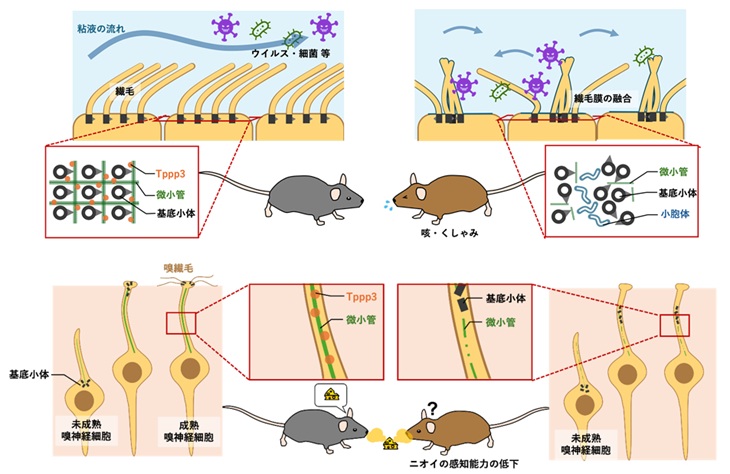
- An international joint research group led by Graduate Student Keishi Sakai of the Tokyo University of Agriculture and Technology Graduate School Graduate School of Engineering Department of Biotechnology and Life Science (at the time of research: currently Assistant Professor) and Professor Kyosuke Shinohara of the Graduate School of Institute of Engineering Division of Biotechnology and Life Science of the same university have investigated the development of Tppp3 (Tubulin Polymerization Promoting in mammalian model mice) Protein Family Member 3) By analyzing the function of genes, we have clarified the mechanism by which ciliary cells in the tracheal epithelium and olfactory epithelium tissues acquire precise orientation and independence of ciliary membrane structure, which were previously unknown. This mechanism allows cilia to grow in the right direction and perform various functions. This result is expected to lead to the elucidation of the mechanism by which respiratory abnormalities and olfactory disorders are caused in the future.
The results of this research were published in the December 1st issue of the Proceedings of the National Academy of Sciences (PNAS).
Title of the paper: Tppp3 determines basal body positioning and identity of respiratory cilia via microtubule assembly and sphingolipid homeostasis
URL: https://doi.org/10.1073/pnas.2503931122
For more details, please see below.
Related links (opens in a new window)
Tokyo University of Agriculture and Technology Graduate School Institute of Engineering / Graduate School of Advanced Interdisciplinary Science Prof. Kyosuke Shinohara
Researcher Profile Laboratory website
Tokyo University of Agriculture and Technology Graduate School Institute of Engineering / Graduate School of Advanced Interdisciplinary Science Yosuke Fukutani Associate Professor
Researcher Profile